
If you’ve been running Amazon ads for a while, you’ve probably felt the frustration: you’re bidding on keywords, getting clicks, but your conversion rate stays low, and ACOS creeps up no matter what you tweak. Most sellers waste budget chasing broad, low-intent traffic—but the real gold is hiding in plain sight: the shoppers who searched for your keywords, clicked your ads, and didn’t buy.
These aren’t random browsers. They’re high-intent prospects who already raised their hand to say, “I want this product.” They just needed a nudge, a better offer, or a second chance to convert. Master this audience, and you’ll unlock 3–4x higher conversion rates than standard traffic—with a fraction of the wasted spend. Below are the 3 non-negotiable, interconnected strategies that make this audience profitable, no fluff, no overcomplication.
1. Prioritize Search-to-Non-Purchase Shoppers: Your Highest-Converting Traffic Source
Let’s start with the foundational truth: search-to-non-purchase audiences are the most valuable traffic you can target on Amazon.
Here’s why this matters more than any other audience type:
A shopper who types in your core keyword, clicks your sponsored ad, and browses your listing has already demonstrated clear purchase intent. They’re not scrolling aimlessly—they’re actively shopping for a product like yours. The only reason they didn’t buy? Maybe they compared prices, got distracted, needed to think it over, or weren’t fully convinced by your listing that first time.
Compare that to broad keyword traffic or random display ad clicks: 100 random shoppers might result in 1–2 sales. But 100 shoppers who already searched and clicked your ads? You’ll see 6–8 sales—3–4x the conversion rate, guaranteed.
This isn’t a “nice-to-have” tactic. It’s the backbone of efficient Amazon advertising. Instead of fighting every seller for generic traffic, you’re focusing on the low-hanging fruit: shoppers who are already halfway to buying from you. Ignore this audience, and you’re leaving the easiest conversions on the table.
2. Build Audiences with Rule-Based Targeting (Max 10 Keywords) – Precision Over Volume
Once you know to target search-to-non-purchase shoppers, the next critical step is building your audience the right way. The single biggest mistake sellers make here is overloading their audience with keywords—and ruining its precision.
Amazon’s AMC (Amazon Marketing Cloud) lets you create two types of audiences: Rule-based and Lookalike. Stick to Rule-based, always.
Rule-based targeting pulls in only shoppers who explicitly searched your chosen keywords and clicked your ads. No guesswork, no system assumptions, no irrelevant users. Lookalike audiences, by contrast, rely on Amazon’s algorithm to “guess” similar shoppers—and that guesswork often brings in low-intent, unrelated traffic that kills your conversion rate.
Even with Rule-based targeting, there’s a hard limit: never use more than 10 keywords per audience.
Why 10? Because every keyword you add dilutes the audience’s intent. Stuff 20, 30, or 50 keywords into one audience, and you’re mixing shoppers looking for your exact product with those searching for competitors, related accessories, or even unrelated items. Suddenly, your “high-intent” audience is a messy mix of buyers and browsers, and your conversion rate plummets.
Stick to 5–10 hyper-relevant core keywords per audience. Keep the intent tight, keep the shoppers focused, and you’ll maintain the precision that makes this audience profitable. Also, set a realistic time window (7 days for fast-moving consumer goods, 14–30 days for higher-ticket items) and make sure your audience size hits at least 2,000 shoppers—too small, and you’ll get no meaningful exposure.
3. Bid 30% Higher for This Audience on Sponsored Products (SP) – Pay More to Win More
You’ve identified your highest-value audience, and you’ve built it with precise Rule-based targeting. Now, you need to make sure your ads actually reach these shoppers—and that means bidding 30% higher than your standard keyword bids on Sponsored Products (SP).
Here’s the simple reality: every serious Amazon seller is targeting this search-to-non-purchase audience. If you bid your normal rate, your ads will get outranked, and you’ll never get in front of these high-intent shoppers. A small 30% bid increase is a tiny cost to pay for 3–4x higher conversions.
Sponsored Products are the best ad type for this audience, too. They’re direct, keyword-aligned, and feel native to the Amazon search experience—exactly where these shoppers are already browsing. Pair your boosted bid with a small coupon or limited-time offer, and you’ll turn those “almost buyers” into actual customers.
Don’t overcomplicate this with SB or SD ads first. Start with SP, one audience, one ASIN, and your core keywords. Once you prove it works, scale slowly. The goal is consistency, not chaos—and a 30% bid lift ensures you capture the traffic that moves the needle.
The Full Loop: 3 Strategies Working Together
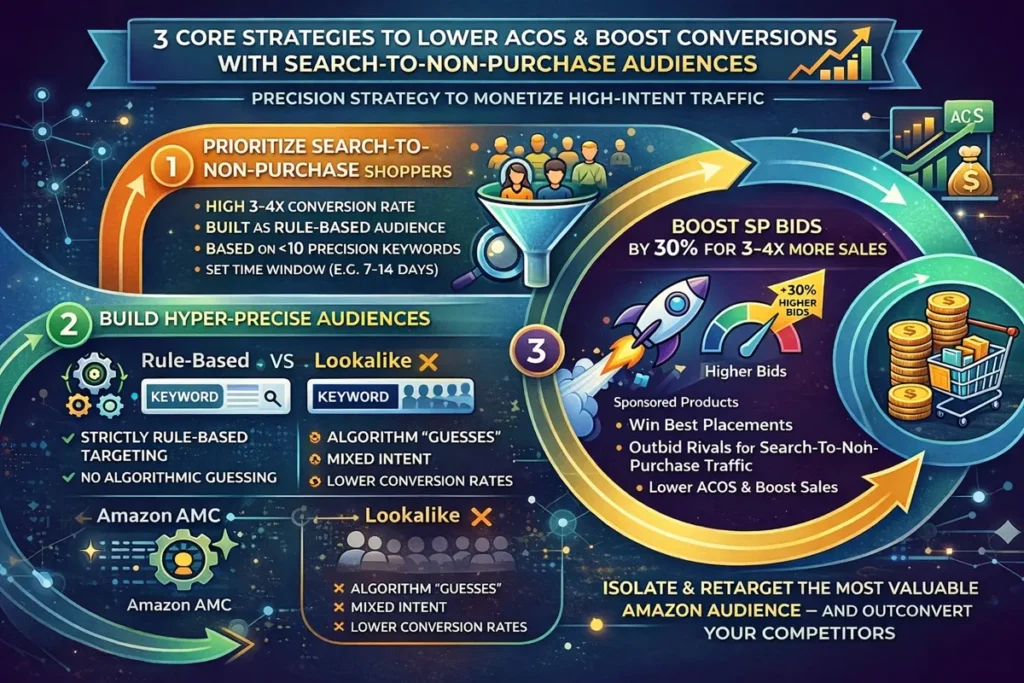
Let’s tie it all together in one simple, actionable cycle:
- Target the right people: Focus exclusively on shoppers who searched your keywords and clicked your ads (the highest-converting group).
- Build precise audiences: Use Rule-based targeting with 10 or fewer keywords to keep intent sharp and avoid messy traffic.
- Win the bid: Boost SP bids by 30% to secure exposure to these valuable shoppers, and watch conversions rise while ACOS drops.
This isn’t about chasing every trick in the Amazon playbook. It’s about mastering one high-leverage strategy that works for every category, every seller, and every stage of growth. Simplify your ads, focus on precision, and let this audience do the heavy lifting for your sales and profitability.