
If you manage paid acquisition for high-volume Shopify brands, you have almost certainly encountered the same recurring nightmare: ad dashboards display healthy, scaling ROAS month after month, yet the client’s bank balance barely grows — or worse, shrinks.
You scale campaigns based on platform-reported performance, trust Meta and Google’s conversion numbers, and allocate bigger budgets to seemingly high-performing ad sets, only to discover dozens of hidden operational costs eroding every dollar of margin by month-end.
For years, media buyers had two imperfect solutions: rely entirely on vanity, self-reported ad platform metrics, or waste hours cross-referencing CSV exports, Shopify orders, dynamic COGS, shipping fees, and refunds inside clunky spreadsheets. This gap is exactly where TrueProfit separates itself.
Far more than a basic bookkeeping tool, its core competitive advantage lies in acting as an independent profit auditor for your media spend. Below, we break down the three most impactful ways advanced advertisers leverage this ad-focused synergy to eliminate waste, bypass attribution distortion, and build sustainable paid growth.
1. Replace Vanity Platform ROAS with POAS: Expose Fake Campaign Profitability
Every major advertising platform calculates ROAS using a dangerously simplistic formula: top-line revenue divided by ad spend. This built-in limitation creates systemic blind spots for DTC operators.
Meta will claim credit for sales that Google Search assisted, Google will overstate PMax performance without accounting for heavy return rates, and neither platform automatically deducts variant-level COGS, weight-based shipping charges, payment gateway fees, or refund losses from reported results. The outcome is widespread “ROAS illusion” that convinces media buyers to scale campaigns that are quietly burning cash.
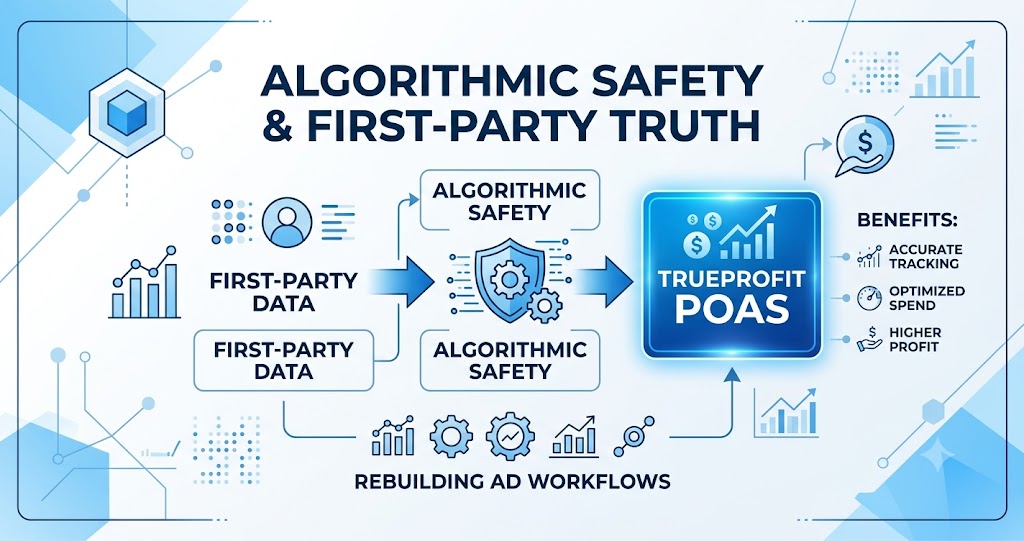
TrueProfit’s ad synchronization delivers its most immediate impact here by shifting the paradigm from ROAS to what is commonly referred to as POAS (Profit on Ad Spend). Once you connect your ad accounts via official APIs, the platform continuously pulls real-time spend, then matches available order-level attribution data with Shopify order economics to calculate residual profit after all variable business costs are subtracted.
📊 Real-World Campaign Audit
A Meta ad set records a promising ROAS of 4.0 inside Ads Manager. On the surface, most media buyers would approve budget increases.
After syncing the same campaign data inside TrueProfit, the system factors in a 35% product return rate, overweight fulfillment expenses, and variant-level procurement costs. The resulting POAS lands at only 0.8. In plain terms: every $1 spent on this ad set delivers negative net contribution.
With POAS, campaign evaluation is no longer dictated by what ad platforms want you to see; all budget decisions anchor to verified post-cost profitability.
2. Neutralize Cross-Channel Attribution Chaos Using First-Party Truth
Nearly all mature Shopify DTC brands run a dual acquisition stack: Meta for cold prospecting, paired with Google Search and Performance Max for high-intent capture.
Because each advertising platform operates its own isolated attribution model, they continuously fight over credit. Meta attributes sales to social touchpoints; Google claims credit for search-originated conversions. In an iOS 14+ and post-cookie world, relying purely on ad platforms’ aggregated API data to de-duplicate conversions is a mathematical dead end. Platforms cannot reliably de-duplicate conversions across competing ecosystems.
TrueProfit resolves this conflict not by blindly trusting ad platform self-reporting, but by establishing a First-Party Data Layer (Single Source of Truth) anchored directly to the Shopify backend.
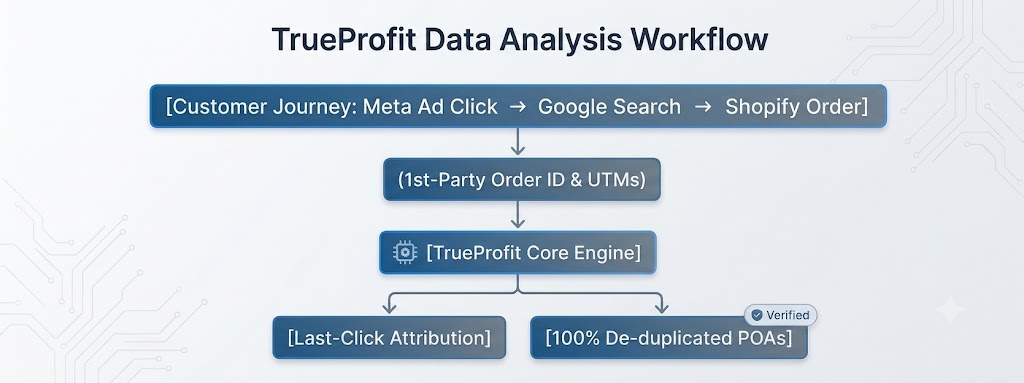
By tracking 1st-party purchase data, order IDs, and precise UTM parameters at the order level, TrueProfit bypasses the self-attribution loops of Google and Meta. Every sale is assigned credit once.
With this unified profit dashboard, advertisers can answer critical questions impossible to resolve using native ad interfaces:
- Which Meta prospecting ads merely harvest warm traffic already primed by Google search?
- Which Google Search keywords compete directly against free organic traffic without driving new incremental buyers?
- What realistic budget split between social and search maximizes total store net profit, instead of isolated channel ROAS?
3. Profit-Driven Smart Bidding on PMax: The Algorithmic Safe Path
Google Performance Max and Standard Shopping Ads rely heavily on machine learning. However, a well-documented flaw of default optimization behavior is that when fed purely revenue-based conversion values, the algorithm may favor high-volume products even when their contribution margins are inferior. It chases easy conversions regardless of underlying profitability, steadily draining margin as campaigns scale.
To scale sustainably, you must guide automated bidding systems toward gross profit instead of raw revenue.
While technical setups allow teams to attempt pushing real-time post-refund net profit back into Meta CAPI or Google Ads through server-side integrations, offline conversion imports, or conversion value adjustment workflows, many experienced operators avoid overly aggressive real-time profit feedback loops. Because refunds, shipping adjustments, and chargebacks can take 7 to 14 days to finalize, feeding delayed, constantly retrofitted conversion values back into Google’s real-time bidding engine often triggers severe algorithmic shock and delivery fluctuations.
The Professional Workflow: SKU Margin Segmentation
Instead of risking real-time conversion value instability, the most robust, battle-tested approach is utilizing TrueProfit’s granular SKU-level profitability reporting to orchestrate your product feeds:
- Extract SKU Profit Margins: Pull historical SKU contribution margins directly from TrueProfit.
- Inject GMC Custom Labels: Map your products into profitability tiers (e.g., High-Margin, Mid-Margin, Low-Margin) inside Google Merchant Center using Custom Labels.
- Isolate Asset Groups: Structure your PMax or Standard Shopping campaigns based on these profit-tier Custom Labels rather than raw revenue categories.
- Targeted tROAS Allocation: Set lower tROAS targets for your high-margin asset groups to aggressively capture high-profit market share, and higher tROAS targets for low-margin items to protect your bottom line.
This structured workflow turns TrueProfit’s backend financial intelligence into front-end algorithmic leverage, protecting both your ad performance and your net margin.
Additional Ad-Focused Advantages Worth Noting
- Ad Set & Creative Layer Profit Breakdown: Higher-tier plans unlock granular ad-level POAS reporting, enabling side-by-side A/B creative testing using profitability as the primary KPI, not just CTR or CPC.
- Multi-Store Aggregated Ad View: Operators running multiple Shopify stores under separate ad accounts can view consolidated cross-brand media spend and combined profit metrics in a single, clean dashboard.
- LTV + Ad Spend Correlation: Link acquisition source data with customer lifetime value to differentiate short-cycle impulse buyers from high-retention audiences, allowing you to safely accept higher initial CPA on channels delivering superior long-term customer profitability.
Final Thoughts For Paid Acquisition Operators
Most media buyers spend countless hours refining bids, headlines, and audience signals, yet ignore the single most important input: whether traffic actually generates sustainable profit once all business costs land. Advertising platforms are built to maximize their own ad consumption; they cannot be trusted to tell you which campaigns are truly viable for your unique margin structure.
TrueProfit fills this critical blind spot. When you combine regular POAS audits, first-party attribution cleanup, and SKU-level profitability analysis, you build an advertising workflow optimized for bottom-line growth — not vanity revenue targets.
If you are still making scaling decisions purely based on native Ads Manager or Google Ads ROAS, you are almost certainly leaving significant profit on the table.