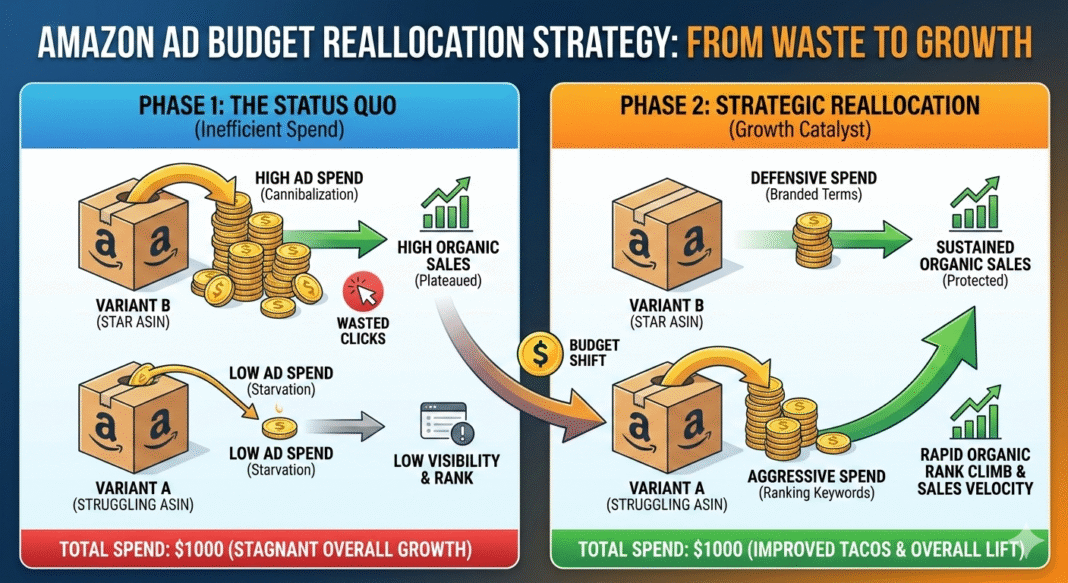

If you’ve been selling on Amazon for a while, you’ve probably faced this scenario: one child ASIN in your listing is a rockstar, pulling in most of its sales organically, while another child ASIN struggles to get noticed without advertising support. Your ad budget isn’t unlimited, so you can’t just throw more money at the problem.
So what do you do? Shut off ads for the strong performer and pour every dollar into the weaker ASIN? Or spread your budget thinly, keeping the strong ASIN safe while trying to lift the weaker one? Many sellers freeze here, unsure which path will bring the best return.
The truth is, this isn’t a gut-feel decision. It’s a resource allocation and growth strategy problem. You need to protect existing profits while investing smartly to grow the ASIN that’s falling behind. This guide walks through a practical, data-driven approach: how to identify which ASIN deserves focus, reallocate budget effectively, and turn a struggling child ASIN into a self-sustaining source of organic sales.
Step 1: Identify Each ASIN’s Lifecycle Stage
Before moving any money around, you need to understand where each child ASIN stands in its lifecycle. This determines the strategy you should use.
Variant B: The “Harvest” ASIN
- About 85% of sales are organic. Amazon’s algorithm already recognizes it as highly relevant and satisfying for customers.
- Spending heavily on ads here often delivers diminishing returns, as many of the sales would have happened anyway.
- Strategy: protect profitability. Keep ads lean and defensive—think branded keywords or exact-match campaigns—but avoid aggressive spend.
Variant A: The “Growth” ASIN
- Natural search visibility is weak, so advertising is essential to drive both sales and ranking.
- Ads are an investment, not just a cost. Every dollar spent should help increase sales velocity and organic ranking over time.
- Strategy: focus on incremental growth, not immediate ACOS efficiency. The goal is to build organic momentum so the ASIN can eventually stand on its own.
Key takeaway: Treating both variants the same is a mistake. Strong ASINs need protection; weaker ASINs need focused investment.
Step 2: Validate Your Assumptions with Attribution Data
Before cutting ads for the strong ASIN, ask yourself: Are these ads actually helping the weaker ASIN indirectly? Sometimes, clicks on Variant B’s ads lead customers to Variant A, generating sales it wouldn’t have gotten otherwise. Ignoring this can backfire.
Amazon provides the Brand Halo Report to answer this question:
- Set the date range (e.g., last 60 days) and filter by Variant A’s ASIN.
- Review all marketing activities that contributed to its performance. Look specifically for clicks from Variant B’s Sponsored Product campaigns.
- Focus on two metrics:
- Detail Page Views: how many times a click on Variant B’s ad led to Variant A’s page.
- Purchases: how often this journey ended in a sale for Variant A.
Decision scenarios:
- Significant assist exists: Variant B ads help drive Variant A sales. Keep a minimal, defensive spend on B while redirecting most budget to A.
- Little or no assist: Ads for B mostly drive B’s own sales. You can safely reallocate its budget to A.
Step 3: Reallocate Budget Strategically
Once you’ve confirmed that shifting budget won’t harm Variant A’s performance, focus your investment where it matters:
Campaign Structure for Variant A:
- Auto Campaign (Discovery) – low bids
- Purpose: uncover new converting search terms.
- Regularly harvest high-performing terms for your manual campaigns.
- Manual Exact Match Campaign (Core) – aggressive bids
- Focus on 5–10 high-converting, core keywords.
- Goal: win sales on priority terms and boost organic rank.
- Manual Phrase/Broad Campaign (Scale) – moderate bids
- Capture broader demand and test new keywords for potential promotion to Exact campaigns.
Optimization Tips:
- Negative keywords: regularly add irrelevant or low-performing terms to prevent wasted spend.
- Bid adjustments: increase bids on top-performing keywords and placements; lower bids on keywords already ranking organically.
- Placement targeting: check reports to see which placements are efficient; adjust accordingly.
Remember: the goal isn’t just ad sales—it’s increasing sales velocity to improve organic ranking.
Step 4: Measure Success Beyond ACOS
For a growth ASIN, the best metric isn’t short-term ACOS—it’s organic ranking and sustainable sales velocity. Monitor:
- Rank movement for core keywords
- Organic vs. paid sales mix over time
- Assist contributions from other campaigns (if applicable)
When Variant A begins to generate substantial organic traffic, it has graduated from being ad-dependent to a self-sustaining part of your listing.
Conclusion: The Art of Strategic Budget Reallocation
The dilemma of deciding where to spend limited ad dollars comes down to a simple, repeatable framework:
- Diagnose lifecycle: Identify which ASINs are “Harvest” and which are “Growth.”
- Validate with data: Use the Brand Halo Report to see if strong ASINs assist weaker ones.
- Reallocate with conviction: Shift budget to the ASIN that will benefit most.
- Optimize campaigns: Use precise targeting, negative keywords, and bid strategies to maximize every dollar.
By following this approach, you’re not just chasing temporary ACOS improvements. You’re building long-term organic momentum, turning a weak ASIN into a star, and making your ad budget work smarter, not harder.