
Let’s dismantle a belief that quietly destroys more Amazon ad accounts than bad creatives or weak listings:
“In Amazon Ads, higher bids mean better traffic.”
That statement is only half true—and the other half is where profitability dies.
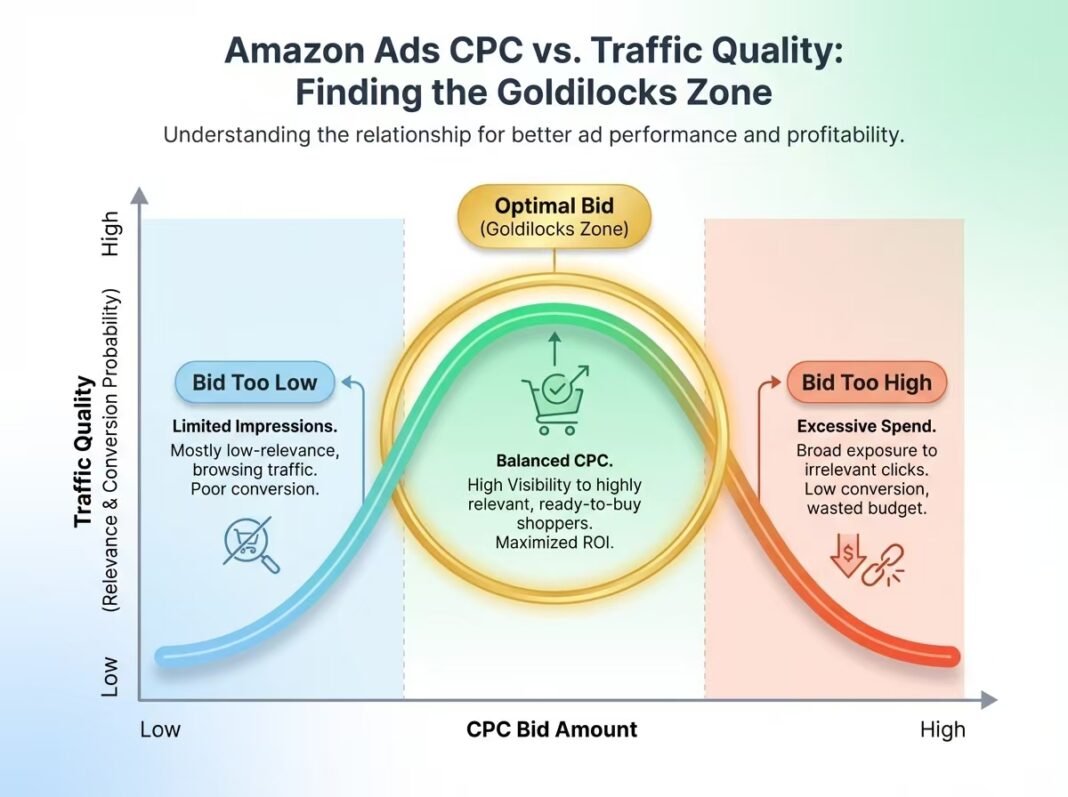
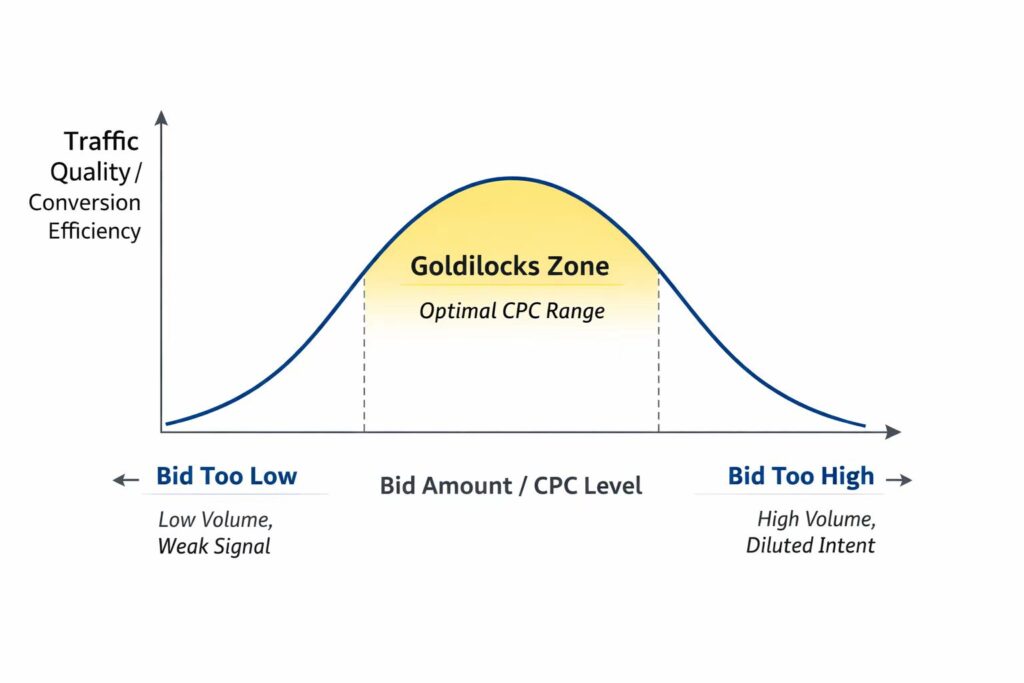
In reality, Amazon Ads operates within a CPC “Goldilocks Zone”: a bid range that is high enough to compete for real buyer intent, but low enough to force the algorithm to remain selective. When your bids move outside this zone, performance doesn’t improve—it degrades, often rapidly.
This is not a bidding trick.
It is a structural property of auction-based algorithms.
What the “Goldilocks Zone” Actually Means
Every auction system—Amazon included—responds to economic signals, not intent requests.
A CPC bid is not a message that says “find me the best buyers.”
It is a constraint that defines how aggressively the system is allowed to spend your budget.
The Goldilocks Zone exists where:
- Your bid is high enough to enter competitive auctions
- But low enough to prevent indiscriminate budget deployment
Once you cross that upper boundary, the algorithm stops optimizing for buyer quality and starts optimizing for spend velocity.
Amazon simply makes the consequences visible faster than most platforms.
The High-Bid Trap in Amazon Ads
When you raise CPCs significantly above the market-clearing level, you are not gaining control. You are surrendering it.
To the A9 / COSMO system, a high bid communicates one thing clearly:
Cost sensitivity is gone. Exposure is the priority.
The system responds exactly as instructed.
What High CPCs Typically Trigger on Amazon
1. Aggressive Search Term Expansion
Sponsored Products begin matching:
- Broad, loosely relevant queries
- Comparison-stage or exploratory searches
- Keywords with weak buyer-product alignment
Click volume increases, but purchase intent collapses.
This is where many advertisers misdiagnose the problem as “bad traffic quality,” when the real issue is over-permissive bidding.
2. Heavy Shift Toward Product Detail Page Placements
One of the clearest warning signs of overbidding is a sudden surge in:
- Product Page impressions and clicks
- With flat or declining sales
This usually happens after a bid increase.
Product Page traffic is not inherently bad—but when fueled by inflated CPCs, it often becomes the fastest way for the system to burn budget, not the most efficient way to drive conversions.
If Top of Search share stagnates while Product Page clicks spike, you are almost certainly outside the Goldilocks Zone.
3. Conversion Rate Decline and Organic Feedback Damage
This is where Amazon differs most sharply from other platforms.
On Amazon:
- Conversion rate is a core ranking signal
- Paid traffic performance feeds back into overall ASIN evaluation
By overbidding and importing low-intent clicks, you are effectively teaching the system that your product converts poorly.
In other words, you are paying to generate negative data about your own listing.
Few advertisers realize how expensive this mistake truly is.
This Logic Is Not Unique to Amazon (Google Ads Works the Same Way)
Many strong Amazon advertisers adapt quickly to Google Ads for one reason:
the underlying logic is identical.
In Google Search campaigns, excessively high max CPCs produce the same pattern:
- Query expansion into marginally relevant searches
- Increased exposure to informational or exploratory intent
- Rising CTR paired with falling conversion rates
Google’s Search Terms Report tells the same story as Amazon’s:
when bids lose discipline, algorithms lose selectivity.
The difference is consequence speed:
- On Google, you mainly damage CPA
- On Amazon, you damage ACoS, conversion rate, and organic momentum simultaneously
Amazon is less forgiving—but also more transparent.
The Low-Bid Problem: When Discipline Becomes Invisibility
Of course, the opposite extreme fails too.
CPCs set too low result in:
- Minimal impressions
- Weak placements
- Insufficient data for algorithmic learning
You are not controlling costs—you are preventing optimization.
The Goldilocks Zone exists precisely because both extremes break the system.
The Correct Mental Model: CPC as a Filter, Not a Weapon
Successful Amazon advertising is not about overpowering auctions.
It is about using CPC as a filtering mechanism.
Your bid should restrict the system to:
- High-intent searches
- Strong buyer-product matches
- Placements where conversion probability justifies spend
When bids are too high, filtering disappears.
When bids are too low, participation disappears.
Only within the Goldilocks Zone does the algorithm have no choice but to behave intelligently.
How to Find Your CPC Goldilocks Zone in Amazon Ads
1. Anchor on ACoS, Not CPC
The right question is never:
“Can I bid higher?”
It is:
“At my current price and conversion rate, what CPC sustains my target ACoS?”
CPC is an input. ACoS is the outcome.
2. Monitor Structural Shifts After Bid Changes
After any bid increase, immediately check:
- Search term relevance breadth
- Placement distribution changes
- Conversion rate stability
If structure changes while sales do not improve, your bid has crossed a boundary.
3. Use Bid Reductions to Force Selectivity
This is the hardest step psychologically.
When impression share rises but performance collapses, the instinct is to:
- Add more negative keywords
- Increase bids further to “fix” volume
Often, the correct move is the opposite.
Lower bids constrain the system and force it to compete only in auctions where buyer intent is strongest.
Final Takeaway
In Amazon Ads, CPC is not a competitive lever—it is an algorithmic instruction.
A bid inside the Goldilocks Zone tells the system:
“Spend carefully. Prioritize buyers most likely to convert.”
A bid outside that zone tells it:
“Stop filtering. Just spend.”
High-performing Amazon advertisers are not those who bid the most, but those who understand how algorithms interpret economic signals—and design their bids accordingly.
That is optimization.
Everything else is gambling.
Q&A: Tools That Help Identify the Right CPC Range in Amazon Ads
Q: Do advertisers really need third-party tools to find the right CPC range on Amazon Ads?
Not necessarily, but they help a lot once campaigns move beyond very small budgets.
Amazon’s native console shows what already happened. Third-party tools are useful because they speed up controlled bid testing and make patterns easier to see, especially when you are trying to identify a sustainable CPC range rather than chasing short-term wins.
Q: What kind of tools are most relevant for testing and adjusting bids?
Tools that focus on bid automation and performance monitoring, not listing optimization or keyword discovery.
The core requirement is simple: the tool should be able to adjust bids incrementally, observe changes in conversion rate and ACoS, and surface those changes clearly in reports.
Q: How do tools like Perpetua, Teikametrics, or Pacvue actually help in practice?
In practice, they remove manual friction.
Instead of changing bids keyword by keyword, these platforms apply structured bid logic across many targets at once. This makes it easier to observe what happens when bids move slightly above or below the category average.
Many advertisers notice a familiar pattern: as bids are pushed up, impressions increase quickly, but conversion rate often softens. When bids are pulled back, traffic volume drops, but efficiency improves. These tools make that trade-off visible much faster.
Q: Does automation replace understanding CPC fundamentals?
No. Automation amplifies whatever logic you give it.
If the target ACoS or efficiency goal is unrealistic, the system may push bids too aggressively or suppress delivery entirely. The tools are most effective when used to test hypotheses about CPC ranges, not to blindly “let the AI run.”
Q: What metrics matter most when using these tools to find a Goldilocks Zone?
CPC alone is not enough. Most experienced advertisers focus on:
- Conversion rate trends after bid changes
- ACoS stability over time, not single-day performance
- Where impressions are coming from (top of search vs. product pages)
When bids move outside a reasonable range, the first signal is usually a conversion rate drop, not an immediate spike in ACoS.
Q: What’s a common mistake advertisers make when using third-party tools?
Expecting a single “perfect” CPC number.
In reality, the Goldilocks Zone is a range, and it shifts as competition, seasonality, and conversion rates change. The value of these tools is not precision, but repeatable testing and faster feedback.
Q: What’s the right mindset when combining bid testing with automation tools?
Think of them as microscopes, not autopilots.
They don’t decide what “good traffic” is. They simply make it easier to see when bids start attracting lower-intent clicks. The judgment still comes from understanding how CPC, conversion rate, and ACoS interact.
That’s ultimately how advertisers find a CPC that is “not too high, not too low, but just right.”