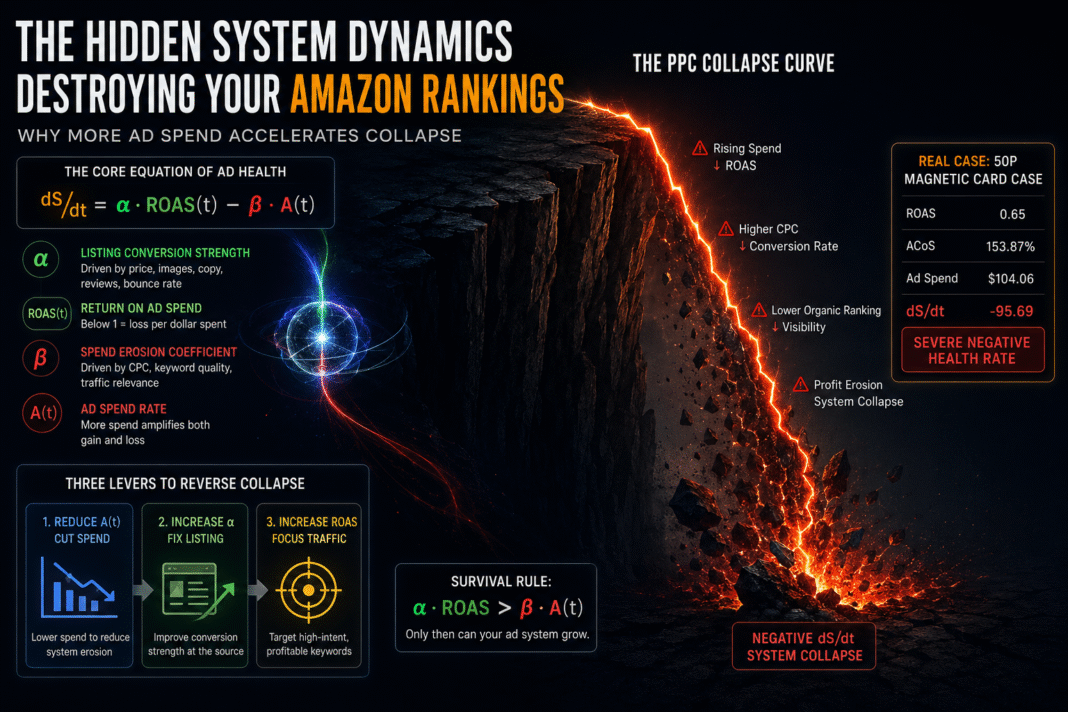

Most Amazon sellers treat PPC problems as isolated issues — weak bids, bad keywords, or rising competition. In reality, the biggest threat is systemic: when ad spend outpaces listing strength, the entire ASIN ecosystem begins to degrade. Higher spend brings more clicks, but often at the cost of worse traffic quality, rising CPCs, falling ROAS, and eventually weakening organic rankings.
This isn’t random. It’s the predictable result of how Amazon’s algorithms interact with your listing quality and campaign structure. Understanding this dynamic is what separates sustainable growth from expensive plateaus.
A Simple Framework for Advertising System Health
Instead of complex physics metaphors, think in terms of a basic balance:
System Momentum ≈ (Conversion Value Generated) – (Traffic Quality Cost)
More formally, we can model the direction of an ASIN’s health over time as:
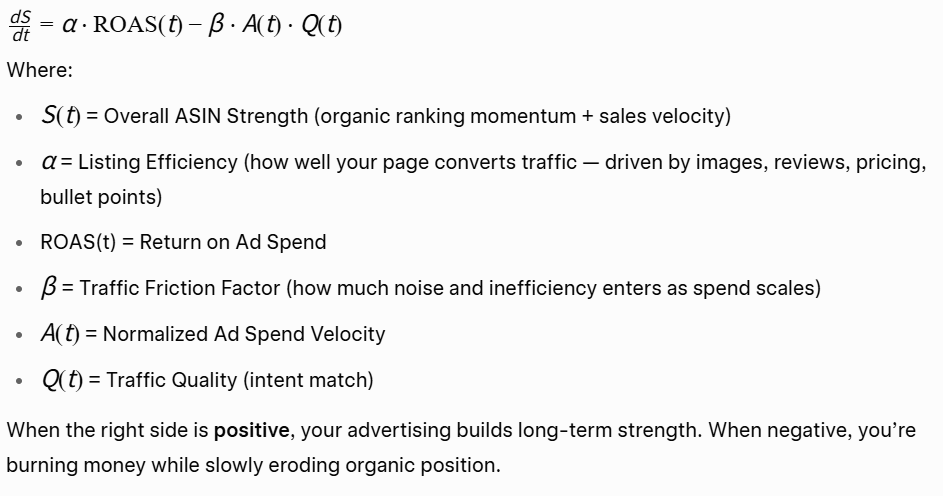
“This is a conceptual framework, not a strict econometric model.”
When the right side is positive, your advertising builds long-term strength. When negative, you’re burning money while slowly eroding organic position.
The Two Core Forces at Work
- Value Creation (α × ROAS) Strong listings turn clicks into sales efficiently. High conversion rates, solid AOV, good review velocity, and clear differentiation create a flywheel: ad sales → better ranking → more organic sales → more data for the algorithm.
- Value Erosion (β × A(t) × Q(t)) As you increase budget, Amazon’s algorithms expand reach. Broad and auto campaigns pull in lower-intent traffic. This raises CPCs, dilutes conversion rates, increases bounce rates, and sends negative signals to organic ranking.
The dangerous zone is when erosion consistently exceeds creation. Many sellers experience the same vicious cycle:
- Increase budget → broader traffic → lower conversion → algorithm deprioritizes the ASIN organically → seller increases budget further to compensate.
Real Example: 50-Count Magnetic Graded Card Slab Case

This niche product has solid fundamentals: $46.99 price point and a targeted collector audience. Yet recent performance showed clear warning signs:
- Ad Spend: ~$50 (relatively aggressive for the category)
- Ad CVR: 1.96%
- Bounce Rate: ~50%
- ACoS: 153.87% (ROAS ≈ 0.65)
Diagnosis:
- Low α (listing efficiency): Only 8 reviews, room for improvement in main image clarity, title structure, and bullet points.
- High β (friction): Automated and broad match campaigns were attracting buyers looking for single slab holders rather than bulk 50-packs.
Plugging approximate values into the framework shows strongly negative momentum. The product wasn’t just “unprofitable on ads” — the ad strategy was actively training Amazon that the listing was less relevant than it could be.
The Critical ROAS Threshold
For any given spend level, there exists a minimum ROAS needed to maintain or grow system strength:

This threshold rises with higher spend and poorer listing quality. In the example above, the seller likely needed ~1.4–1.6 ROAS just to break even on system health at current spend levels. Running at 0.65 guaranteed decay.
How to Reverse the Decay (Practical Levers)
Instead of endless bid tweaking, focus on these three high-leverage actions:
1. Reset Spend Velocity (Short-term Stabilization) Temporarily reduce budget significantly (e.g., from $50/day to $15/day). This immediately cuts low-quality traffic, reduces negative signals, and gives the listing breathing room. Many accounts see organic stabilization within days.
2. Strengthen Listing Efficiency (α)
- Update the main image with clear, high-contrast text overlay: “50-Pack Magnetic Graded Card Slab Case – PSA/BGS Fits”.
- Refine title, bullets, and A+ content to speak directly to serious collectors.
- Encourage review velocity through early Vine or coupon strategies if appropriate. A stronger listing acts as a natural filter and amplifier.
3. Improve Traffic Precision (Lower β and Raise Q)
- Pause or heavily negative broad/auto campaigns.
- Shift budget to a tight set of exact and phrase match long-tail keywords with proven intent (e.g., “50 pack magnetic graded card case”, “bulk psa slab holders”).
- Aggressively harvest search term reports and add negatives weekly.
The New Mindset for 2026 and later
Stop asking only “What’s my ACoS today?” Start asking:
- Is this campaign building or destroying long-term ASIN strength?
- Does my listing deserve the traffic I’m buying?
- Am I scaling profitably, or just buying volume at the expense of organic equity?
The winners in Amazon advertising aren’t necessarily those with the biggest budgets. They are the ones who maintain strong listing fundamentals while scaling traffic intelligently. They treat PPC as a precision tool for momentum — not a crutch for weak listings.
When your advertising system creates more value than it destroys, growth becomes compounding rather than exhausting.