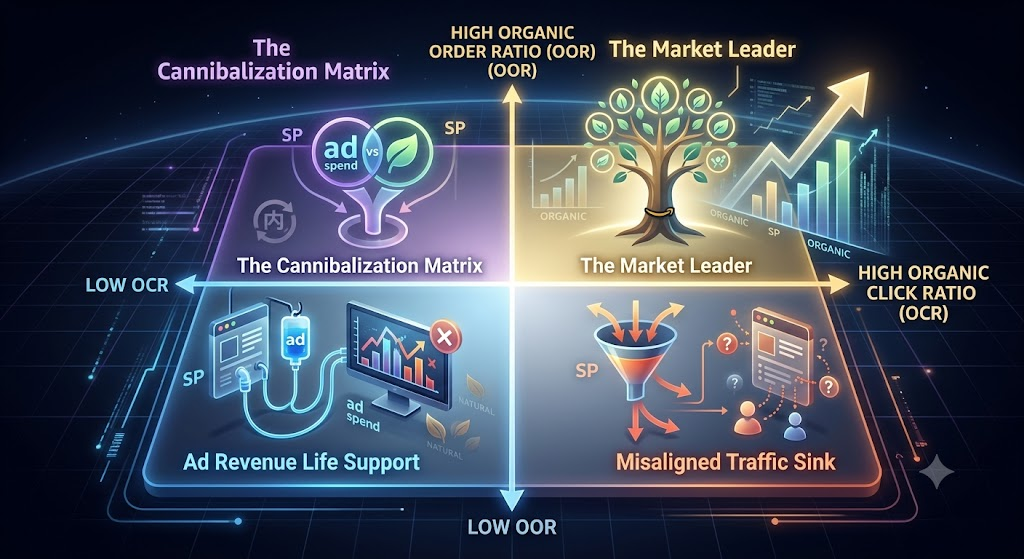


In the contemporary landscape of Amazon marketplace dynamics, a profound structural shift has rendered traditional Pay-Per-Click (PPC) optimization techniques largely obsolete. For years, brand owners treated retail media as a linear vending machine: you insert a specific cost-per-click (CPC), and the machine dispenses a corresponding unit of sale. Success was measured within the narrow, isolated perimeter of Advertising Cost of Sales (ACOS).
However, looking at the architecture of Amazon’s marketplace through a systems-analysis lens reveals a completely different reality. The marketplace is not a static catalog; it is a high-frequency, dynamic optimization engine governed by complex sorting algorithms. In this environment, viewing advertising merely as a transactional tool to “buy traffic” is a fundamental strategic error.
The elite tier of global sellers treats advertising as a tool to buy algorithmic trust. The ultimate objective is not the immediate margin of the ad-triggered sale, but rather the structural manipulation of organic search rankings to achieve a state of continuous organic momentum.
Below is a deep analytical deconstruction of the mechanics governing this “Momentum Game” and how structural variables dictate product velocity on the platform.
1. The Core Philosophy: From Traffic Acquisition to Algorithmic Synergy
To understand the core philosophy of algorithmic synergy, one must analyze the ultimate end-state of a successful Amazon product launch: Dual Placement.
When a consumer searches for a high-intent keyword, a dominant brand shouldn’t just occupy an isolated sponsored slot. The product must simultaneously occupy the top-tier sponsored position and the absolute peak of the organic search results. This dual presence creates a powerful psychological layout for the consumer and forms a highly protective defensive perimeter against market competitors.
Achieving this requires a radical shift in how ad spend is capitalized. Traditional accounting classifies PPC expenditures as variable marketing costs.Algorithmic Orchestration, however, treats initial ad spend as an intangible capital investment—a strategic entry fee paid directly to the algorithm to purchase data validation.
Every click and conversion generated via PPC feeds clean, high-intent behavioral data into Amazon’s ranking system. When the system observes a consistent, high-velocity conversion profile, it rewards the underlying ASIN with elevated organic positioning. Therefore, the true ROI of an advertising campaign cannot be calculated on the ad dashboard alone; it must be evaluated by the expansion of organic market share and the subsequent deflation of Total Advertising Cost of Sales (TACOS).
2. The Multi-Channel Funnel: Strategic Segmentation of Media Formats
A common mistake in retail media execution is the simultaneous, uncoordinated deployment of all available advertising formats. This creates internal data noise and dilutes cross-functional budgets. A structured approach segregates Amazon’s primary ad units into distinct operational tiers based on the maturity of the product’s data profile.
Sponsored Products (SP): The Core Engine of Velocity
Sponsored Products represent the foundational baseline of the traffic infrastructure. Because these ad units are natively integrated directly into the search results and product detail pages, they feature the shortest path to conversion. In the initial phases of a product lifecycle, Sponsored Products must command the vast majority of capital allocation. They are responsible for establishing the baseline sales velocity and proving the conversion viability of the ASIN to the algorithm.
Sponsored Brands (SB): Cognitive Capture and Moat Building
Sponsored Brands should rarely be deployed during the volatile infancy of a product. Instead, they serve as a scaling mechanism once the underlying Sponsored Product data profile has stabilized and the brand possesses at least three highly converting, interrelated SKUs. Sponsored Brands capture top-of-funnel search intent and protect brand search terms. They shift consumer perception from a transactional product consideration to a holistic brand ecosystem, effectively driving up customer lifetime value (LTV).
Sponsored Display (SD): Contextual Interception and Retargeting
Sponsored Display functions as a precision tactical weapon rather than a broad-spectrum traffic driver. Its primary utility lies in cross-category interception on competitor detail pages and off-platform retargeting of abandoned shopping carts. By placing display units directly beneath the buy box of competing listings, a brand can legally siphon high-intent traffic at the exact moment of purchase decision, closing external loopholes where potential conversion energy might leak.
3. The 8-Day Rolling Velocity Window: The Algorithmic Chokepoint
At the heart of Amazon’s structural ranking methodology lies a critical temporal constraint: the rolling assessment window, frequently observed as an 8-day velocity cycle.
When a new ASIN is introduced to the catalog, the algorithm initiates a data “cold start” phase. During this brief window, the system grants the product an artificial baseline of structural visibility to test its performance metrics against established category benchmarks. The algorithm is primarily measuring two critical variables: Sales Velocity and Unit Session Percentage (Conversion Rate).
During this 8-day window, any friction or interruption in data delivery introduces massive system disorder (entropy). If a brand manager panics because the first-week ACOS is unsustainably high and subsequently pauses the campaigns, lowers bids aggressively, or allows inventory to lapse, the algorithm receives a definitive stagnation signal. The system immediately downgrades the ASIN’s risk profile, categorizing it as a low-yield asset and stripping away its initial organic ranking advantages.
The strategic conclusion here is absolute: During the initial rolling velocity window, short-term profitability must be entirely deprioritized in favor of volume and data purity. It is far more capital-efficient to absorb high advertising losses in week one to lock in a permanent premium organic rank, than to spend months attempting to revive a stagnant, data-starved listing through incremental bid adjustments.
4. Analytical Precision: The Pivot to Low-Entropy Keywords
To survive the rolling velocity window without completely exhausting corporate capital, execution must pivot away from high-energy, hyper-competitive search environments. Targeting broad, high-volume search terms (e.g., keywords with monthly search volumes exceeding 5,000 or 10,000) during a product’s infancy is a high-risk approach. These high-volume keywords are highly chaotic environments characterized by intense bidding wars, volatile conversion rates, and heavy ad fatigue.
Instead, tactical positioning dictates the isolation of high-intent, long-tail search terms—specific niche queries where consumer intent is highly defined.
While these long-tail keywords possess lower absolute search volumes, they feature significantly lower market resistance and vastly superior conversion predictability. By systematically capturing a matrix of these low-resistance keywords, a brand can build an aggregated baseline of sales velocity safely insulated from dominant category incumbents. Once these micro-niches are fully captured and stabilized, the product acquires the structural strength required to scale into high-volume keyword segments.
5. The Pricing-Traffic Matrix: The Ultimate Dynamic Game
Advanced market analysis eventually reveals that advertising optimization cannot exist within a vacuum. A retail media strategy is fundamentally tied to a product’s price point.
Conversion rate (CVR) is not an isolated metric determined solely by listing copy or photographic assets; it is a highly fluid variable constantly reacting to the real-time pricing movements of neighboring competitors. If a competitor drops their price by 15% while your automated ad campaign maintains a rigid keyword bid, your ad spend will inevitably begin to burn through cash without generating sales, because your relative conversion value has collapsed.
To counter this, advanced market practitioners are abandoning static pricing and rigid ad management models in favor of integrated, real-time economic equilibrium platforms. Sophisticated mathematical architectures—such as the predictive algorithmic systems pioneered by platforms like Profasee—have fundamentally redefined this space.
Rather than treating retail pricing as a fixed bookkeeping entry and PPC as an isolated marketing task, these modern systems treat them as a single, unified dynamic matrix. By evaluating real-time price elasticity alongside live ad conversion trends, the system can execute high-frequency adjustments to both listing prices and ad positions concurrently.
- If a listing’s conversion rate begins to soften under heavy competitive ad pressure, the system can dynamically optimize the retail price point by a fraction of a percentage to instantly restore the ad’s conversion efficiency.
- Conversely, when the product captures the top organic spot and establishes strong momentum, the system can subtly expand profit margins without disrupting the underlying organic ranking velocity.
Final Analytical Synthesis
Ultimately, navigating the modern Amazon ecosystem requires abandoning legacy, human-centric management philosophies. The marketplace is an automated ecosystem that responds exclusively to structural data inputs.
- Advertising is an external accelerator: Its primary strategic function is to buy algorithmic validation, driving the product toward a permanent state of dual-placement dominance.
- The 8-day window is absolute: The initial cold-start phase requires a commitment to data velocity and volume over short-term unit economics.
- Cohesive automation is mandatory: True operational efficiency is achieved only when the artificial silos between traffic acquisition, dynamic inventory management, and price elasticity are completely eliminated.
Brands that continue to manage their operations through fragmented spreadsheets and isolated marketing departments will inevitably face rising structural inefficiencies. Survival belongs to the practitioners who understand how to configure their operational systems to align perfectly with the platform’s core algorithmic rules, turning marketplace dynamics into an automated engine for sustainable, long-term growth.