
Amazon’s enforcement of the strict 75-character title limit across all non-media categories marks the most aggressive platform-driven “information entropy reduction” in ecosystem history.
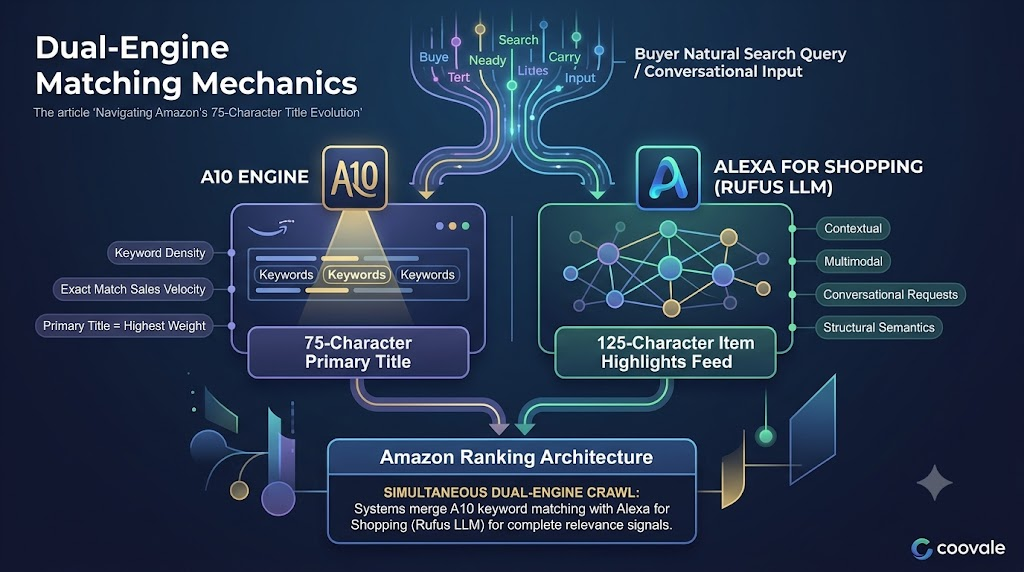
Many traditional sellers view this update as a traffic crisis, attempting to address it via mechanical cutting or blindly dumping keyword lists into the new Item Highlights (125 characters) field. This execution-level mindset completely ignores the massive shift occurring under the hood: the merging of Amazon’s A10 keyword-matching algorithm with Alexa for Shopping (which integrates the Rufus LLM).
When legacy, bloated titles are stripped away, a listing’s raw organic footprint naturally contracts. To win in this new era, sophisticated brand operators must deploy a three-dimensional data architecture—High-Energy Focus at the front end, Semantic Feeding at the second tier, and Comprehensive Indexing in the backend—while recalibrating the PPC architecture to maintain structural relevance and prevent traffic hemorrhaging.
1. Algorithmic Foundation: The Alexa for Shopping & A10 Symbiosis
1.1 The Dual-Engine Matching Mechanics
The traditional A10 algorithm operates on keyword density, proximity, and exact-match sales velocity. Alexa for Shopping (the evolutionary iteration integrating the Rufus LLM), by contrast, handles contextual, multimodal, and conversational requests leveraging advanced semantic vector matching.
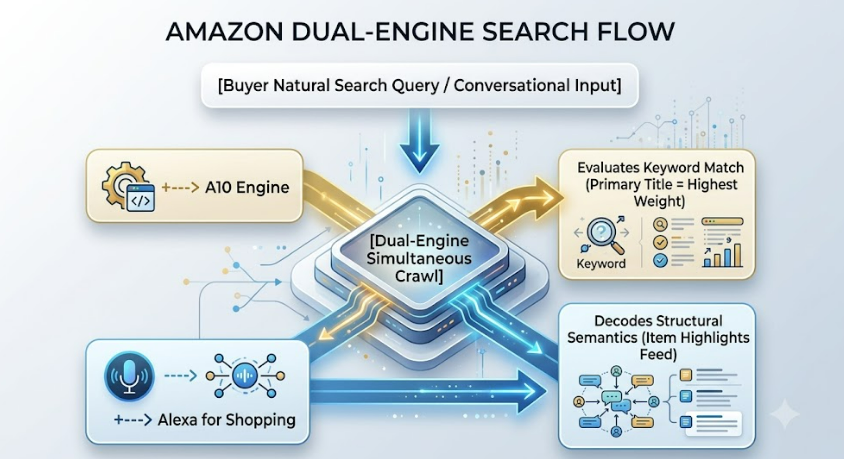
Amazon’s ranking architecture does not isolate these engines to read specific fields independently; rather, both systems simultaneously crawl the entire front-end copy.
- 75-Character Primary Title: This remains the highest-energy zone for the search infrastructure. The cleaner and less cluttered your primary title, the easier it is for Amazon’s algorithms to lock onto your product’s core entity. Cutting redundant textual noise generally improves listing relevance signals, which may gradually lower baseline average CPCs over time.
- 125-Character Item Highlights: This field acts as the primary data diet for the Alexa for Shopping conversational engine. Its purpose is not to host comma-separated keyword stuffing, but to provide Structured Semantics that align with natural human inquiries and voice/text shopping logic (e.g., “Which air fryer liners fit the Ninja Crispi without leaking oil?”). While Item Highlights are fully search-indexable, primary title core entity terms carry higher priority signals for A10’s keyword matching flow.
1.2 The Penalty of Automated AI Re-Writes (Auto-Hosting)
Amazon’s automated AI rewrite tool systematically overwrites non-compliant ASINs. Brand Registered sellers receive a 14-day manual override review window to reject or modify these automated edits before they go live permanently. Merchant reports reveal three critical failure points of these automated rewrites:
- Arbitrary Stripping of Critical Compatibility Modifiers: This instantly decimates broad organic traffic for electronics accessories and home appliance parts.
- Miscategorization of the Core Entity: This misleads the A10 engine, triggering a drop in organic rank and an immediate spike in PPC auto-campaign CPCs.
- Destruction of Variation Logic: AI rewrites often copy and paste identical titles across variations, flattening conversion rates (CR) on the detail page.
2. The Three-Dimensional Listing Restructuring Framework
Do not just truncate your titles. We must dissect all existing product data into a Five-Layer Intent Model and redistribute the assets across distinct structural layers.
2.1 The Five-Layer Intent Allocation Model
| Intent Layer | Data Attributes | Structural Placement |
|---|---|---|
| L1: Core Category Term | Air Fryer Liners, USB C Hub | 75-Char Title (Absolute Priority) |
| L2: Core Spec & Compatibility | for MacBook Pro M3, 100PCS | 75-Char Title / Highlights Header |
| L3: Decisive Pain-Point Fix | No-Leak, Scratch-Resistant | Item Highlights / Variant Attributes |
| L4: Scenario & Material Modifiers | for Travel, Food-Grade Paper | Highlights Tail / A+ Text Copy |
| L5: Long-Tail & Hidden Synonyms | Niche search terms, regional variants | Backend Search Terms (ST) |
2.2 Four High-Conversion, Entropy-Reduced Title Templates
Rule: Ruthlessly eliminate empty fluff like
Premium,Upgraded, orHigh-Quality. Every character must carry clear algorithmic value.
- Consumer Electronics & Accessories (Compatibility-Driven):
Formula: Brand + Core Category Term + Key Spec + Exact Device Compatibility
Example: Baseus 7-in-1 USB C Hub, 100W PD Charging for MacBook Pro M3 (61 chars)
- Home, Kitchen & CPG (Spec & Pain-Point Driven):
Formula: Brand + Top Functional Modifier + Core Category Term + Target Machine + Pack Size
Example: Joyami No-Leak Disposable Air Fryer Liners for Ninja Crispi, 100PCS (71 chars)
- Multi-Variation (Parent/Child Structural Formula):
Formula: Brand + [Variant Attribute Front-loaded] + Core Category + Core Comp/Size
Example: Anker [2-Pack, Black] USB C Cable 6ft for iPhone 16 Pro Max (62 chars)
- Lifestyle & Scene-Driven Goods:
Formula: Brand + Core Category + Core Functional Value + Primary Use Case
Example: ErgoDrive Portable Adjustable Laptop Stand for Desk and Travel (64 chars)
2.3 Item Highlights Semantics (Not a Secondary Title)
Highlights must read as cohesive, benefits-driven statements tailored to Alexa for Shopping’s conversational data retrieval patterns.
- ❌ Incorrect (Keyword Stuffing): Food Grade, Heat Resistant, Non-Stick, Oil Proof, For Baking, Ninja Liners.
- 🎯 Correct (Semantic Feeding): Fits Ninja Crispi air fryers perfectly. Raised edges block oil spills. Food-grade paper withstands 220°C heat for baking and reheating.
2.4 Reclaiming the Backend: The Search Terms (ST) Deep Reservoir
Because the short title sheds 100+ characters, your Backend Search Terms (ST) and Alt-Text (image text vectors) must serve as your tactical fallback. Move all secondary long-tail keywords, synonyms, and uncompliant modifiers into the backend ST to preserve your net index size.
3. Full-Funnel PPC Playbook: Preventing Message-Targeting Disconnect
The most catastrophic post-optimization error is narrowing your front-end listing copy while leaving your PPC matching parameters wide open. If your title becomes hyper-focused but your ad campaigns continue to bid on broad, generic phrases, the algorithm notes a conversion disconnect, leading to an immediate drop in your Quality Score and inflating your CPCs.
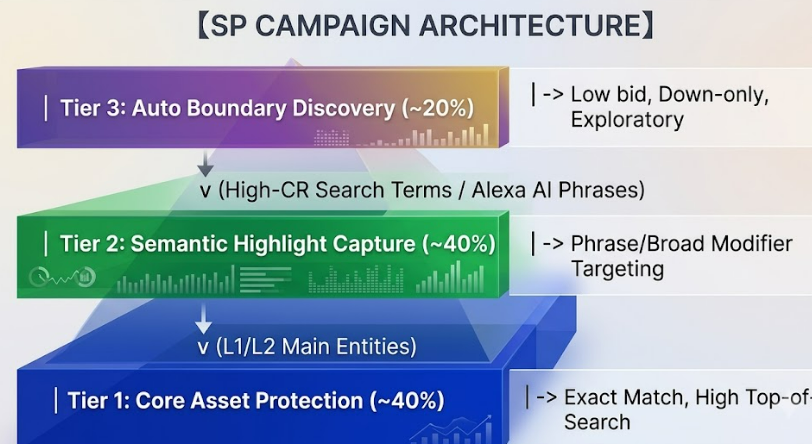
Note: These allocation percentages serve as baseline benchmarks; adjust Tier 1/3 shares up or down for cold-launch new listings (higher Tier 3) or mature flagship ASINs (higher Tier 1) accordingly.
3.1 Sponsored Products (SP) Multi-Tier Budget Realignment
Tier 1: Core Asset Protection Campaigns (~40% Budget Allocation)
- Targeting: Exact Match only on the L1/L2 core terms retained in your 75-character title.
- Execution: Set a 20%–30% bid modifier for Top of Search (First Page). These targets represent your core identity; driving conversions here sends maximum positive signals to the search architecture, accelerating organic rank stickiness on high-volume terms.
Tier 2: Semantic Highlight Capture Campaigns (~40% Budget Allocation)
- Targeting: Phrase Match or Exact Long-Tail targeting of the material, scenario, and pain-point modifiers relocated to Item Highlights.
- Execution: This layer captures mid-funnel traffic with highly efficient ACoS. It systematically catches the exact intent phrases that Alexa for Shopping surfaces during voice or conversational customer searches.
Tier 3: Auto Boundary Discovery Campaigns (~20% Budget Allocation)
- Targeting: Automatic Campaigns (Close and Loose match groups enabled).
- Execution: Run a conservative daily budget paired with Dynamic Bids – Down Only. This acts as an automated tool to discover new search behavior patterns under the AI model. Harvest high-conversion customer search terms weekly, move them to Tier 2 campaigns, and inject them into your Item Highlights text asset.
3.2 Sponsored Brands (SB) Cross-Channel Creative Alignment
With the Brand Name forced to the front of 75-character titles, brand recognition becomes heavily amplified.
- Creative Sync: The Headline copy of your Sponsored Brand banners must abandon empty marketing text and directly replicate the “Short Title + Primary Pain Point” messaging to achieve a tight visual closed-loop.
- Brand Defense: Establish an isolated Brand Keyword Exact Campaign with dedicated budgets to lock up your own brand search result pages, preventing competitors from poaching traffic.
3.3 Sponsored Display (SD) Conquesting Script
The shorter title mandate forces cleaner mobile layouts, amplifying the visual discrepancy between clean and messy product detail pages.
- ASIN Conquesting: Direct your SD product targeting campaigns specifically at competitors who still run legacy, unoptimized, long titles (or listings that have been butchered by Amazon’s AI auto-rewrite tool). Your clean, mobile-optimized copy will capture higher CTRs right on their own detail pages.
4. Phase Rollout & Data Diagnostics Matrix
Never update your entire catalog at once. System-wide indexing shock can corrupt baseline attribution data.
4.1 The Three-Phase Phased Migration Strategy
- Phase 1 (The Anchor Phase): Keep your top 20% high-volume, high-revenue ASINs completely stable to protect corporate cash flow baselines.
- Phase 2 (The Scout Phase): Test your new title templates and Item Highlights structures on clearance SKUs or cold/newly-launched variations. Run for 7 full days to chart indexing velocity and CTR reactions.
- Phase 3 (The Rollout Phase): Once you pin down the precise structural formula for your niche, migrate your catalog in rolling batches: Long-tail SKUs $\rightarrow$ Mid-tier Performers $\rightarrow$ Core Flagship ASINs.
4.2 Post-Optimization Diagnostic Framework
Allow the algorithm 7 to 14 days to re-index structural changes before modifying inputs again. Evaluate performance using this troubleshooting logic:
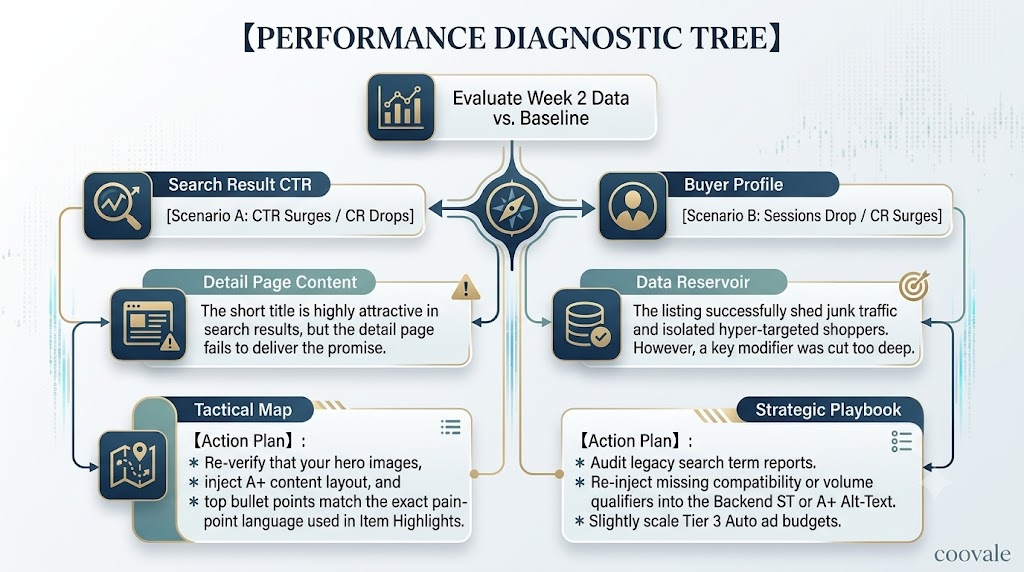
Conclusion
Amazon’s 75-character structural shift is an open invitation to embrace absolute Clarity and Order.
While average sellers complain about losing their keyword-stuffed safety blankets, elite brand operators recognize the grand strategy of the Alexa for Shopping and A10 evolution: Keep the front end concise, feed clean semantic structures to the AI engine, hide long-tail catch-nets in the backend, and deploy highly targeted ad campaigns against unoptimized competitors.
By treating this transition as a deliberate framework of information entropy reduction, you transform a mandatory compliance task into a comprehensive listing upgrade. Re-architecting your storefront into a three-dimensional ecosystem—where your front-end title grips the search engine, your Item Highlights feed the LLM, and your backend harbors the long-tail index—replaces legacy clutter with mathematical predictability. Execute this layout flawlessly, and turn this algorithm transition into a permanent competitive advantage.
Appendix: Strategic Q&A & Infrastructure Tooling Alignment
Q1: With the primary title limited to 75 characters, how can we accurately identify L3–L5 long-tail keywords for backend vs Item Highlights?
A: This is no longer a manual keyword selection problem—it is a semantic compression problem across competitive ASIN clusters.
The most efficient workflow uses Helium 10 (Cerebro + Frankenstein) as a reverse-engineering layer rather than a keyword tool.
- Semantic Extraction (Cerebro):
Run multi-ASIN reverse lookups on top-performing competitors, prioritizing listings that recently experienced volatility under Amazon’s AI-driven title and content re-optimization systems. The goal is not volume, but high-intent convergence phrases that consistently map to conversions across multiple ASINs. - Noise Reduction (Frankenstein):
The exported keyword set should be treated as raw linguistic data. Frankenstein is used to eliminate duplication and low-signal variations, producing a condensed semantic map of the category. - Allocation Logic:
- High-intent, conversational, or problem-specific phrases → Item Highlights (front-end indexing pressure)
- Structural variants, synonyms, spelling noise, regional modifiers → Backend Search Terms (index breadth preservation)
This effectively separates conversion semantics vs indexing semantics, rather than “frontend vs backend keywords”.
Q2: How do we automate execution of the SP Three-Tier Playbook without manual drift?
A: Manual PPC management introduces latency between signal detection and budget reallocation, which in Amazon’s auction system translates directly into margin leakage.
Platforms like Intentwise function as a decision execution layer on top of Amazon Marketing Stream (AMS).
- Signal Layer:
It captures search term-level behavior changes in near real-time, identifying when Tier 3 discovery traffic begins to exhibit conversion stability. - Decision Layer:
Rule-based systems can then:- downgrade non-performing discovery terms into negatives
- promote validated search queries into Tier 2 phrase structures
- Capital Allocation Layer:
Budget is dynamically redistributed toward high-confidence exact match structures (Tier 1), reducing CPC inflation caused by broad match leakage.
In effect, it replaces manual campaign editing with continuous allocation logic based on live conversion signals.
Q3: Will impressions drop after shortening titles?
A: A controlled reduction in impressions is expected and structurally healthy.
By removing redundant keyword saturation, you are effectively narrowing Amazon’s candidate retrieval surface area. This reduces exposure to low-intent queries.
However, the system typically rebalances within a short window:
- CTR increases due to better query alignment
- CVR improves due to reduced semantic noise
- Organic rank stabilizes as conversion efficiency signals strengthen
What appears as “loss of reach” is actually a compression of traffic entropy into higher-quality demand clusters.