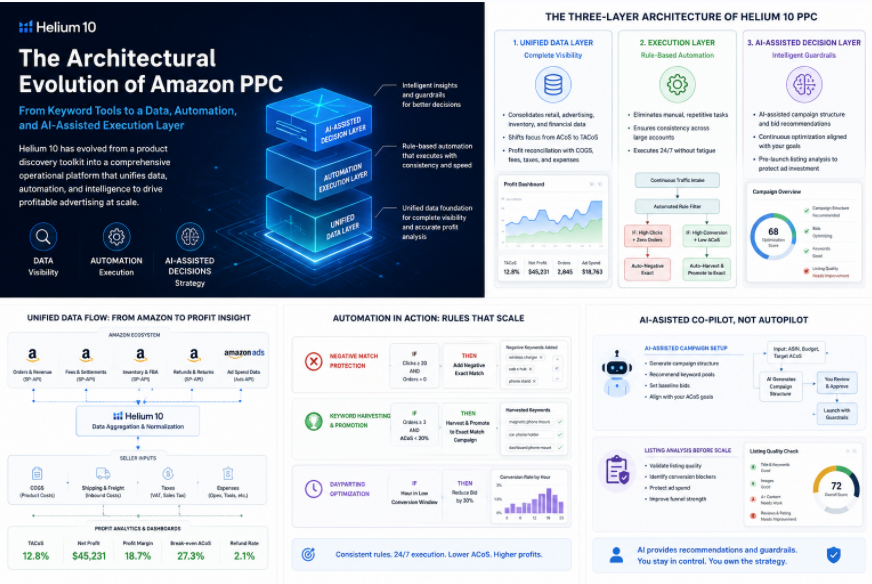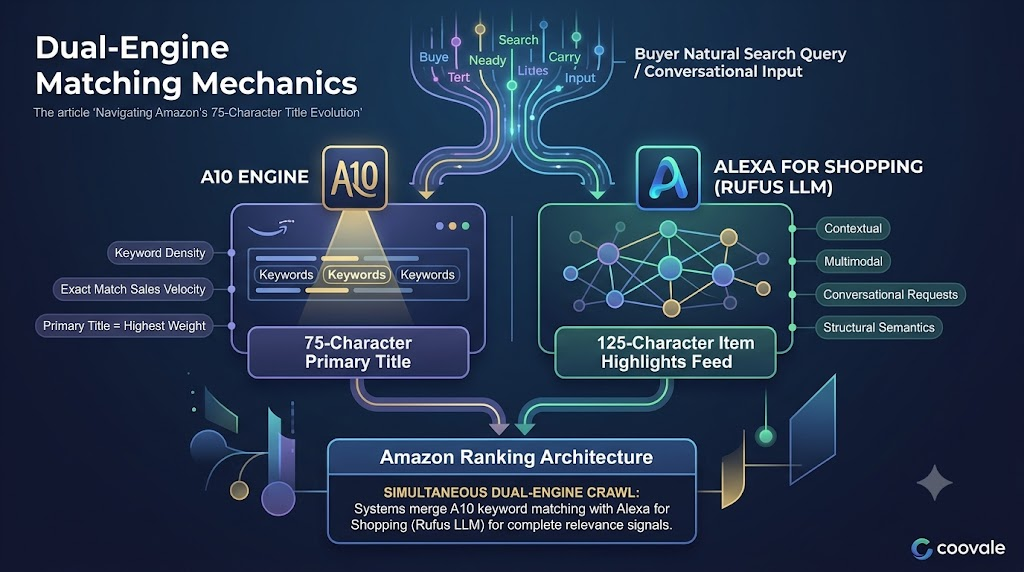


The Amazon advertising ecosystem is undergoing a clear shift in infrastructure. For years, brands have cycled through predictable operational phases: we moved from manual spreadsheets to rule-based automation engines (legacy “IF-THEN” software), and recently experimented with conversational AI Copilots that require constant human prompting.
Today, we are observing the early stages of a fourth paradigm: Autonomous Agents. As an emerging AI-native Amazon advertising platform, Autron.ai focuses primarily on autonomous campaign management, positioning itself at the frontier of this shift. They aren’t pitching a standard analytics dashboard; they are engineering a framework where an AI agent loops through an Observe, Think, Plan, and Execute cycle semi-autonomously.
However, handing over the keys of your primary revenue engine to an autonomous system introduces complex operational variables. Below is a commercially grounded analysis of Autron.ai’s architecture, its performance incentives, and the critical guardrails required to safeguard an account’s bottom line.
1. The Commercial Model: Re-aligning Incentives Around Ad Sales
One of the most notable aspects of Autron’s positioning is its performance-tier pricing. While legacy software platforms and traditional agencies typically bill based on a percentage of Ad Spend, Autron’s Pro tier charges a base fee ($99/month) plus a commission tied directly to Ad Sales generated by the platform.
[ Legacy SaaS / Agencies ] ───> Driven by Ad Spend ───> Risk of Budget Inflation (Entropy)
[ Agentic Models (Autron) ] ───> Driven by Ad Sales ───> Driven by Top-Line Scaling
From an account governance perspective, this structure addresses a historical conflict of interest. When a service provider’s revenue scales with budget consumption, it can introduce artificial inflation (or spend entropy) into the ad account. Tying fees to top-line performance signals a structural alignment with the seller’s growth objectives.
The Operator’s Caveat
While this model is a significant step forward, an experienced media buyer must approach it with a degree of healthy conservatism. Ad Sales do not automatically equal Net Profit.
In high-velocity or low-margin categories, an autonomous agent chasing top-line revenue might scale bids aggressively on high-volume keywords. In practice, if the associated ad spend grows disproportionately, it can drive impressive revenue numbers on paper while eroding actual gross margins. The pricing framework is far more aligned with seller intent than legacy spend-percentage models, but operators must remember it is not a direct proxy for a net-profit-driven strategy.
2. Technical Architecture: Workflow Layers as the Core Differentiator
A common misconception in early commentary is that Autron’s value lies entirely in its model picker—the ability to connect user queries to Claude, ChatGPT, Gemini, or Grok. From an engineering standpoint, the underlying large language model (LLM) is simply a reasoning commodity.
Based on its current positioning, the platform appears designed to support an LLM-agnostic workflow architecture, where a significant portion of its differentiation seems to come from its Proprietary Workflow Layer.
The architecture appears to handle data sanitization and deterministic processing before the AI model even touches the data:
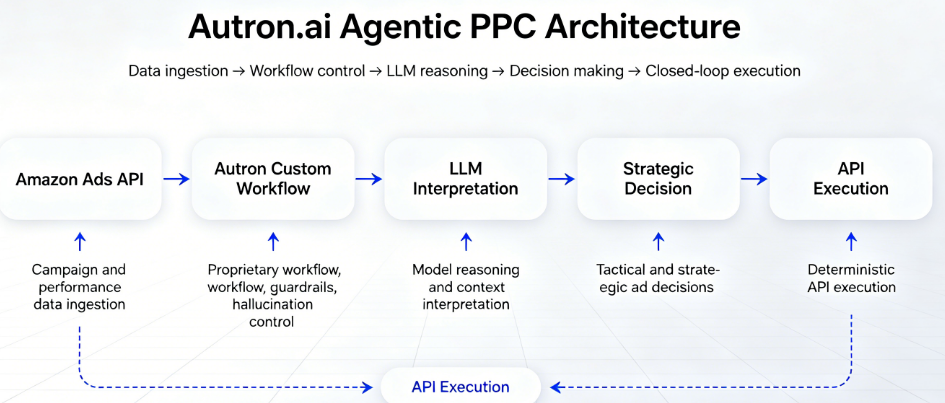
The core system logic seems to emphasize custom software rules that ingest raw Amazon Ads and Selling Partner API data, package it neatly within the model’s context window to minimize hallucinations, and enforce execution boundaries. The LLM serves as the processing muscle, but the internal workflow architecture is likely what prevents the system from taking erratic, low-dimensional actions in the ad account.
3. The Exploration Paradox: Managing the Learning Phase
When deploying an agentic system, the underlying algorithm is designed to continuously balance two distinct behaviors: Exploration (discovering new keyword opportunities, auto-targeting, and mapping placement dynamics) and Exploitation (optimizing and harvesting known converting targets).
Because an agent is built to test variables dynamically rather than follow rigid, static rules, its initial “cold start” or learning phase requires careful management.
Implementing Budget Guardrails
In early deployments, some users have reported rapid campaign expansion and bid fluctuations during the exploration phase. When a multi-SKU account is granted full automation, the agent may launch wide-ranging data experiments to map out competitive auctions. If left entirely unconstrained, this exploratory behavior can create a high volume of granular campaigns, resulting in short-term spikes in ad spend.
This behavior is a natural mathematical byproduct of an autonomous agent optimizing a new environment. To prevent these exploration cycles from impacting capital efficiency, operators must proactively establish hard system boundaries—or Budget Guardrails—within the platform’s control panel:
- Learning Budget Caps: Explicitly isolating a minor, fixed percentage of capital dedicated solely to algorithmic testing.
- Max Bid Limits & ACoS Thresholds: Hard caps that prevent the agent from overbidding on highly competitive terms during aggressive exploration spikes.
4. Asymmetric Optimization: The Caution Behind Negative Target Selection
A highly consistent operational pattern observed across modern autonomous ad engines is their relative caution regarding negative keyword optimization.
When an operator or an AI applies a negative target, they are executing a restrictive action: they are permanently shrinking the search space. Within machine learning logic, cutting off a traffic source carries an opportunity cost. If macro consumer behavior shifts during a seasonal cycle, that blocked phrase might have turned profitable.
[ Keyword Harvesting ]  ───> Expands Search Space ───> High Algorithmic Confidence
[ Negative Target Info ] ───> Shrinks Search Space  ───> High Algorithmic Caution
Consequently, autonomous systems are typically highly efficient at harvesting new keywords and expanding competitor ASIN targets, but tend to be deliberately slow when pruning wasteful spend via negative matches. For brands running hyper-lean operations with minimal margin for non-converting search terms, maintaining a manual oversight routine for the negative keyword log remains a necessary practice.
5. The Structural Boundary: Moving from PPC to a Retail Media OS
To evaluate any emerging ad tech platform with absolute rigor, we must look at the boundaries of what advertising APIs can achieve when siloed from the rest of the business. Traditional software looks exclusively at ad data—click-through rates, conversion rates, and ACoS—to make localized tactical adjustments.
However, the long-term evolution points toward a broader Retail Media Operating System (RMOS)—which serves as a unified operational layer connecting advertising, real-time inventory, finance, and cross-channel decision-making.
An advertising agent cannot achieve true, holistic account optimization if it operates in a data vacuum. Operational efficiency on Amazon is a multi-variable equation that spans across the entire enterprise:
Without real-time integration into inventory and supply chain data, an ad agent might continue driving aggressive traffic to an ASIN that is on the verge of running out of stock, leading to a costly stock-out that breaks organic ranking. Similarly, if the tool cannot parse true contribution margins or product return rates, it may over-optimize a product line that drives high ad sales but yields a net loss for the business.
The major milestone for the next generation of ad tools will be how deeply they integrate with the Selling Partner API (SP-API) and financial data layers to achieve true, business-wide optimization.
The Strategic Verdict: The Sandbox Protocol
Autron.ai provides a highly capable look at the automation models that will eventually standardize Amazon advertising. It offers substantial operational leverage for lean brand teams or solo founders looking to eliminate the administrative friction of micro-managing daily bids.
For established brands with native media-buying teams, a practical starting point is a Sandbox Protocol built around a controlled observation window:
- Isolate the Environment: Select a single, stable sub-brand or 1–2 mature ASINs with predictable traffic to serve as your testing sandbox.
- Configure Safety Controls: Rigorously define your budget ceilings, maximum bid allowances, and target performance ranges inside the platform before enabling full automation.
- Evaluate Macro Metrics: Allow the system a clean, 30-day observation window to navigate its initial exploration phase. Assess the trial based on high-level business indicators: Total ACoS (TACOS) and Inventory Velocity.
By managing the implementation through controlled, localized trials, brands can safely capture the efficiency of agentic workflows while maintaining absolute command over their operational margins.