
If you’ve been advertising on Amazon for more than a few years, you’ve felt the shift. The playbook that once delivered predictable results—bid aggressively on a handful of high-volume keywords, fight for the top spot, and watch the sales roll in—now feels increasingly unreliable. The same budget, the same keywords, yet the returns are volatile, almost like playing a game of chance.
The instinct is to ask, “What am I doing wrong?”
The real question, however, is, “Is the game I’m playing still the same game Amazon is running?”
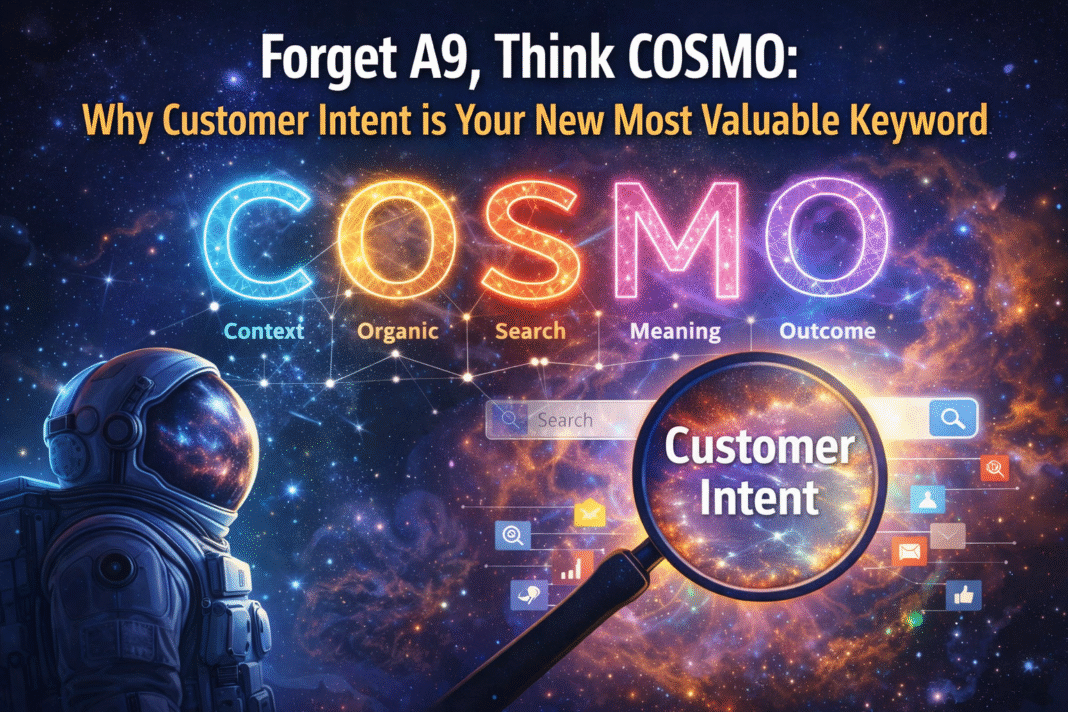
The answer is no. The underlying logic of Amazon’s ecosystem is evolving from a simplistic, keyword-centric model to a sophisticated, intent-based one. We’ve moved from the era of A9, which acted as a meticulous librarian, to the dawn of what is increasingly referred to as the COSMO era, where the system behaves more like an intuitive, context-aware shopping concierge. Winning today isn’t about who can buy the best spot for a keyword; it’s about which product the system has the most confidence in for a specific customer’s underlying need.
This article will deconstruct this shift and provide a actionable framework for aligning your advertising strategy with this new reality. The goal is not short-term sales spikes, but long-term, sustainable growth built on system-level trust.
The Fundamental Shift: From Librarian (A9) to Concierge (COSMO)
To grasp the new strategy, we must first understand the change in the system’s “personality.”
- A9 as the Librarian: Think of the classic A9 algorithm as a highly efficient library catalog system. Its primary job was to index. It checks your product listing: “Does the title contain the keyword? Do the bullet points? Is the backend search terms field populated? Is the category correct?” Its focus was on identity and eligibility. It asked, “Does this product have the right credentials to be considered for this search query?” Competition was about winning a position in a ranked list.
- COSMO as the Concierge: The newer, more nuanced layer of the system (which we’ll call COSMO for clarity) acts like a world-class hotel concierge. A guest (customer) approaches with a request. The concierge doesn’t just fetch a generic solution; they ask clarifying questions based on the guest’s tone, the time of day, and past preferences. Similarly, for the same search query, “water bottle,” COSMO evaluates the searcher’s context, history, and behavior to discern intent. Is it a parent looking for a spill-proof bottle for a child? A marathon runner needing a lightweight hydrator? An office worker wanting a stylish stainless-steel cup?
The concierge doesn’t just care about “what you are” (your keywords); it cares about “what the customer needs at this moment, and whether you are the right fit for that specific need.”
This is why you can feel performance change without altering a single word in your listing. The system is no longer just looking at the words you’ve written; it’s analyzing your performance across different shades of customer intent.
Reimagining Relevance: Your Two-Layer Foundation
The concept of “relevance” is the cornerstone of visibility, but it’s often misunderstood as a single, monolithic score. It’s more accurate to break it into two distinct layers:
- Static Relevance: Your Ticket to the Dance
This is your foundational, on-page optimization. It’s the non-negotiable prerequisite that answers the question, “Can the system understand what you are?” It includes:
- Content Consistency: Perfect alignment between your title, bullet points, description, A+ content, and backend keywords.
- Categorical Accuracy: Correct category and product type selection.
- Attribute Completeness: Filling out all relevant product attributes (size, color, material, etc.).
- Clear Imagery: Images that instantly communicate the product’s use and key features.
If your static relevance is weak, you are, in effect, failing to get your ticket stamped for entry. No amount of advertising genius can save a product that the system can’t properly categorize and understand.
- Dynamic Relevance: Your Performance on the Dance Floor
This is where the new game is played. Dynamic relevance is the measure of how customers respond to your product after they see it. It’s the feedback loop that tells the concierge, “You were right to recommend this one!” Key metrics include:
- Click-Through Rate (CTR): How enticing is your product when shown for a particular intent?
- Conversion Rate (CVR): Once clicked, does it convert? This is the ultimate signal of fit.
- Post-Click Behavior: Do customers spend time on the page? Add to cart? Make repeat purchases?
- Negative Signals: A high return rate or negative reviews for a specific search term tells the system, “This was a bad recommendation.”
Static relevance gets you in the door. Dynamic relevance determines whether you get a prime spot on the main floor or are left standing by the wall. Your advertising strategy is the primary lever for influencing dynamic relevance at scale.
The New Value of Advertising: Buying Trust, Not Just Clicks
Historically, advertising was viewed as a direct transaction: spend money to acquire immediate sales and ranking. In the COSMO era, its value is more profound and strategic.
Advertising is the fastest way to purchase the system’s trust.
By running ads, you are paying to generate a concentrated burst of real shopping signals. When you perform well for a specific intent cluster, you are essentially conducting a controlled experiment for the algorithm. You’re saying, “Watch this. When you show my product to customers with this need, good things happen.”
The system registers this success and begins to extrapolate: “This product is a reliable solution for that type of problem.” Consequently, it gains the confidence to show your product organically to a wider audience sharing that same intent. You are not just buying a sale; you are investing in your product’s identity within the Amazon ecosystem.
The “Intent-Scaling” Playbook: A Practical Framework
So, how do you operationalize this? The old way of managing a few keyword-focused campaigns is obsolete. The modern approach is to manage portfolios of customer intents. I call this the “Intent-Scaling” or “Portfolio” playbook.
Phase 1: Discovery & Library Building
Your first task is to move beyond a keyword list to an “Intent Library.” Stop asking, “What keywords are people searching for?” and start asking, “What are the reasons someone would buy my product?”
Sources for building this library are readily available:
- Customer Reviews & Q&A: This is gold. How do your customers describe why they bought it and how they use it? Look for mentions of gifting, specific use-cases, and problems solved.
- Competitor Listings: Analyze their bullet points and A+ content. What reasons to buy are they emphasizing?
- Search Term Reports: Your existing ad reports are a treasure trove of the language real customers use.
Group these reasons into intent clusters. For a high-quality coffee mug, this might include:
- Gifting: (Gift for Dad, Holiday gift for coworker)
- Scenario-Specific: (Office mug, Travel mug, Car cup holder)
- Need-State: (Durable mug, Leak-proof, Keeps coffee hot for hours)
- Audience-Specific: (Mug for men, Mug for teachers)
Phase 2: Stratified Testing & Signal Amplification
Do not launch all intents with equal budget. Structure your campaign portfolio in tiers:
- Tier 1 (Core Intent): Target intents with the strongest, most direct connection to your product’s core function (e.g., “16oz insulated coffee mug”). This is your foundation. Maximize conversion here first.
- Tier 2 (Expanded Intent): Test broader scenario and audience-based intents (e.g., “commuter travel mug,” “gift for coffee lover”). This is where you scale.
- Tier 3 (Exploratory Intent): Allocate a small budget to very broad intents (e.g., “best gifts”) with strict performance monitoring. This is for discovery.
The Power of Bounded Broad Match:
This is a critical tactical shift. While exact and phrase match feel safe, they limit the system’s ability to learn the full spectrum of an intent. Instead, use Broad Match with strategic negative phrase matching.
- Let’s say your Tier 2 data shows that “gift for dad” is a high-value intent root.
- Instead of only using Exact Match on that phrase, create a Broad Match campaign for the root term:
“gift for dad”. - Before launching, add negative keywords for irrelevant themes you’ve discovered (e.g., “gift for dog,” “gift for mom jewelry”).
- Now, let the campaign run. The system will use its semantic understanding to match your ad to searches like “father’s day present,” “best gift for father,” “what to get my dad.” All of these variations point to the same core intent.
- By allowing this “bounded” expansion, you are feeding the system positive conversion signals for the entire intent cluster, dramatically strengthening your dynamic relevance for “gifting” as a whole.
Phase 3: Convergence & Optimization
Continuously analyze the data from your intent portfolio.
- Scale Winners: Increase budget for intents with strong conversion rates.
- Optimize Contenders: For intents with high click-through but low conversion, ask why. Does your listing properly speak to that scenario? Do you need to add an image or A+ content section?
- Prune Losers: Do not hesitate to negative keywords or pause intents that are unprofitable. Continuing to spend on them only pollutes the system’s understanding of your product.
Conclusion: Becoming the Obvious Choice
The evolution from A9 to COSMO is a move towards a more intelligent, customer-centric ecosystem. The winners in this new environment will not be the brands with the biggest budgets for the top keyword, but the brands that are most successful at demonstrating—through a sophisticated advertising strategy—that they are the obvious solution for a well-defined set of customer needs.
Stop fighting for position. Start building trust. Your goal is to make your product the one the Amazon concierge confidently, and repeatedly, recommends.