
In the high-ticket e-commerce landscape, the standard media buying playbooks are fundamentally broken. If you are launching a premium brand with a price point north of $200—such as the Artemis LED Light Therapy Mask—and your scaling strategy relies on aggressive bidding on broad keywords or endless creative testing without direction, you are essentially donating your capital to ad platforms.
High-ticket e-commerce inherently operates in a high-entropy environment. Traffic costs are volatile, consumer skepticism is at an all-time high, and attention spans are shorter than ever. To scale profitably, we must treat the entire multi-channel ecosystem as a predictable system governed by the immutable laws of physics and probability.
By implementing two core mathematical equations, we can map out a precise, bulletproof blueprint for the Artemis LED Mask launch that cuts through market noise and builds an uncopyable operational moat.
Model 1: The Ad Kinetic Energy Formula (Overcoming Consumer Inertia)
When launching a premium skincare device, your primary adversary is Consumer Friction (R). A qualified consumer browsing social media has zero native affinity for a newly launched brand, and their psychological defense mechanisms are highly active when confronted with an unexpected $250 purchase decision.
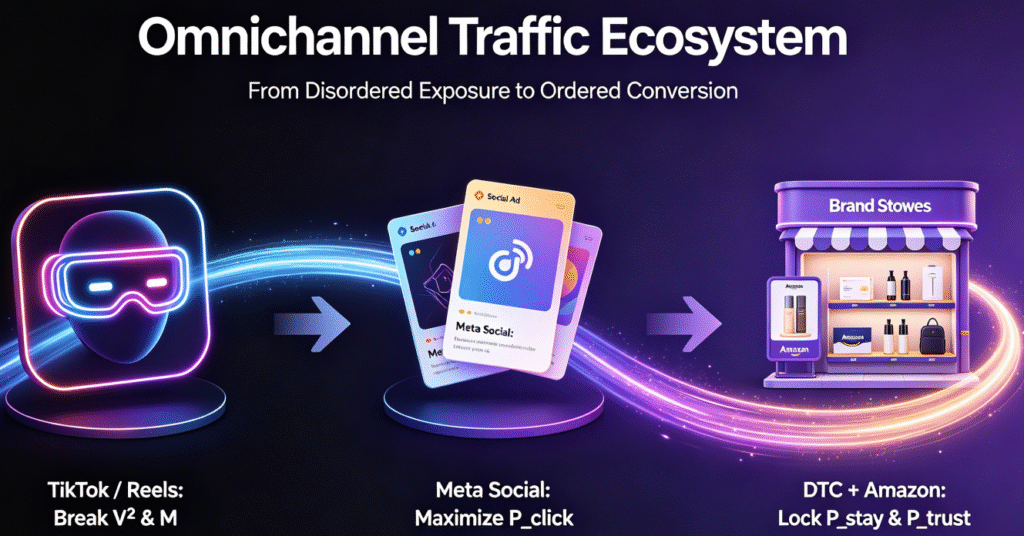
To transition a prospect from passive scrolling to active purchase intent, your creative must generate enough Kinetic Energy (Ek) to cleanly rupture that psychological wall. We model this dynamic using a classic kinetic energy framework:
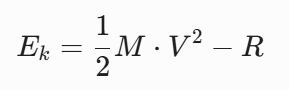
- M (Mass of the Creative Hook): The raw psychological density of your hook. For Artemis, this is the visual gravity of its sleek, full-face hard-shell design featuring a massive 324 LED diode matrix, juxtaposed with a visceral consumer pain point—such as chronic acne breakout cycles or the soaring costs of clinical dermatologist visits ($150+ per visit).
- V (Velocity of Attention Capture): The speed at which your creative hooks the eye within the critical first 3 seconds. Velocity is squared (V2). A linear increase in your opening visual speed yields an exponential, squared increase in the kinetic energy delivered to the funnel.
To maximize V2, the primary channel is TikTok and Instagram Reels. The optimal creative features short-form vertical videos where a creator activates the mask in a dimly lit room, instantly cycling through the intense Red, pure Blue, and mixed dual-spectrum modes. By pulling this visual velocity (V2) into the first 2 seconds, and framing the product as a 15-minute nightly wellness ritual that replaces chaotic skincare routines (maximizing M), you generate an immense surge of kinetic energy that cleanly overrides the customer’s financial friction (R).
Model 2: The Probability Resonance Funnel (Securing the ROI)
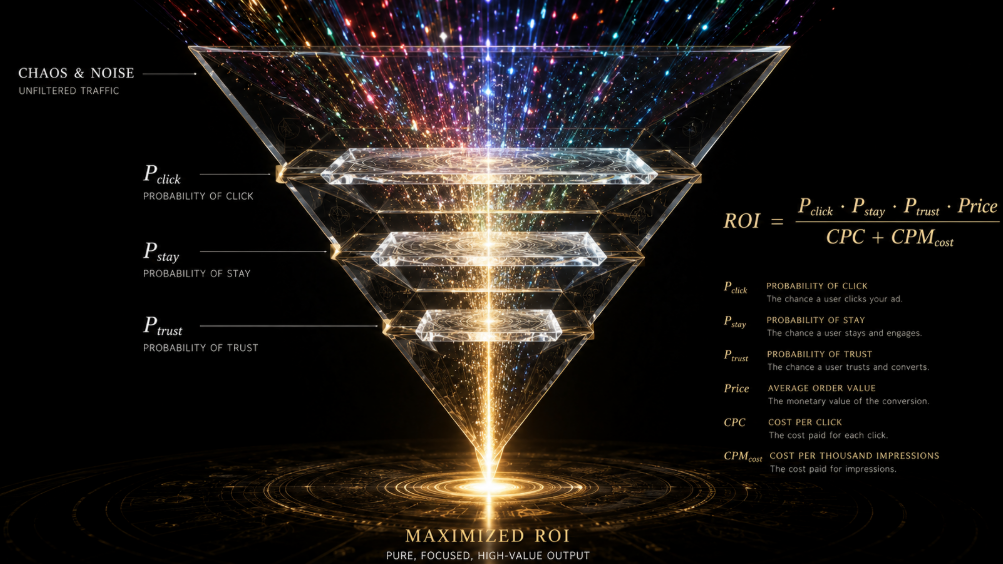
Once traffic lands on your storefront, the challenge transitions from physics to pure probability. We map your Return on Investment (ROI) using the Probability Resonance Model:
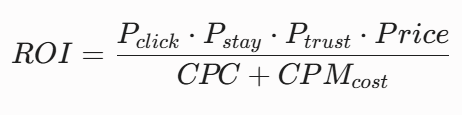
The Mathematical Derivation: Stripping Away the Noise
Macroeconomically, ROI=Total Ad SpendTotal Revenue. For a consumer to purchase the Artemis Mask, they must pass through three independent behavioral gates in sequence:
- They must see the ad and choose to click (Probability=Pclick).
- They must arrive at the landing page, experience zero friction, and choose to stay (Probability=Pstay).
- They must review the specifications, overcome checkout anxiety, and trust the brand (Probability=Ptrust).
According to probability theory, the absolute conversion probability is the product of these variables: Pclick⋅Pstay⋅Ptrust. Therefore, for any given volume of impressions:
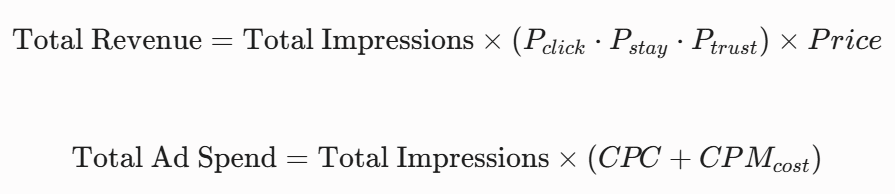
When we place Revenue over Ad Spend, Total Impressions cancels out equally from both the top and bottom. This leaves us with the core probability skeleton of the funnel, proving true ROI is governed entirely by behavioral alignment and cost containment.
Technical Implementation Blueprint: Direct Solutions & Workflow QA
To translate these high-dimensional mathematical formulas into daily operational revenue, your execution layer must be equipped with specialized enterprise software designed to isolate, measure, and optimize every individual variable.
Q: In Model 1, how do we systematically map out and iterate on high-velocity hooks (V2) without wasting thousands of dollars on unoptimized creative production?
A: Creative engineering requires data-driven reverse engineering. You do not speculate on what visuals will capture human attention; you dissect what has already proven to hold traction in the auction.
- Foreplay: This tool is vital for top-of-funnel creative workflow. It allows you to build a permanent, cloud-based digital swipe file of active competitor ad accounts directly from the Meta and TikTok Ad Libraries. You can capture and archive the exact ad frameworks of elite legacy players in the beauty-tech space. Use it to break down their video timelines second-by-second. See exactly when they drop a visual pattern interrupt, how they frame the mask on a model, and hand those proven script parameters to your content creators to guarantee a high baseline velocity (V2).
- Minea: A premium ad intelligence and spy platform that monitors global social engagement metrics. It allows you to sort active e-commerce campaigns by view count, virality score, and spend trajectory. By analyzing real-time data on which skincare and wellness gadgets are scaling right now, you acquire immediate intelligence on what specific creative themes possess the structural “Mass” (M) required to shift consumer psychology.
Q: Looking at Model 2, if our ROAS begins to decay mid-campaign, how do we diagnose whether the breakdown is occurring at the ad level (Pclick) or page level (Pstay)?
A: Standard ad managers provide macro-metrics like standard Conversion Rate, but they obscure granular user behavior. You must run deep diagnostics on the creative-to-landing-page transition.
- Motion: This software integrates directly with your Meta Ads Manager, transforming dense, unreadable spreadsheets into clear, highly actionable visual retention graphs. Motion maps out the precise user drop-off curve for every second of your ad videos. If your retention curve plunges vertically within the first 2 seconds, your Pclick is compromised because your hook lacks velocity (V2). If the video holds a flat, high retention rate all the way through to the call-to-action, but your sales are low, the ad has executed its job perfectly, and the leak is isolated entirely to your landing page performance (Pstay or Ptrust).
- Hotjar: This user-experience analytics tool provides heatmaps, click maps, and session recordings of real users navigating your online store. For a high-ticket investment like the Artemis Mask, you can actively watch where users stall. If they scroll down to the pricing block or the technical description of the 324 LED matrix and immediately exit the site, you have clear proof that your copy is introducing cognitive friction, which is actively degrading your Pstay variable.
Q: How do we optimize the trust probability (Ptrust) on our storefront specifically for a high-ticket device?
A: Align the page architecture with the precise mechanics of the mask’s 3 targeted light therapy modes to eliminate buyer skepticism.
- Loox: This premier review and social proof aggregator allows you to showcase stunning, high-definition before-and-after customer transformation photos directly on the landing page. For a $250 device, standard text reviews do not move the needle. By integrating Loox, you present undeniable, visual proof that validates the scientific efficacy of the mask’s specific wavelengths—such as the 630nm+850nm Red/NIR mode for collagen synthesis, the 415nm+850nm Blue/NIR mode for acne eradication, and the combined deep renewal mode. Seeing real, unedited skin transformations instantly maximizes Ptrust and triggers conversion.
Q: How do we prevent multi-channel tracking degradation from inflating our platform costs (CPC+CPMcost) and misallocating ad spend?
A: In the modern privacy era, ad platforms over-report data by claiming credit for the same purchase. This artificial inflation creates data chaos, leading media buyers to scale campaigns that are actually losing money.
- Triple Whale: The definitive data operating system for scaling independent e-commerce brands. It utilizes a first-party server-side pixel to bypass platform attribution errors. Triple Whale maps the true, uncorrupted multi-touch journey of your customers. It will show you the exact sequence: that a buyer was originally hooked by a high-velocity TikTok video, re-engaged by a Meta economic calculation ad , and ultimately converted through a Google brand search ad. This keeps your true Customer Acquisition Cost (CAC) completely transparent, allowing you to cut unprofitable ad sets with mathematical confidence.
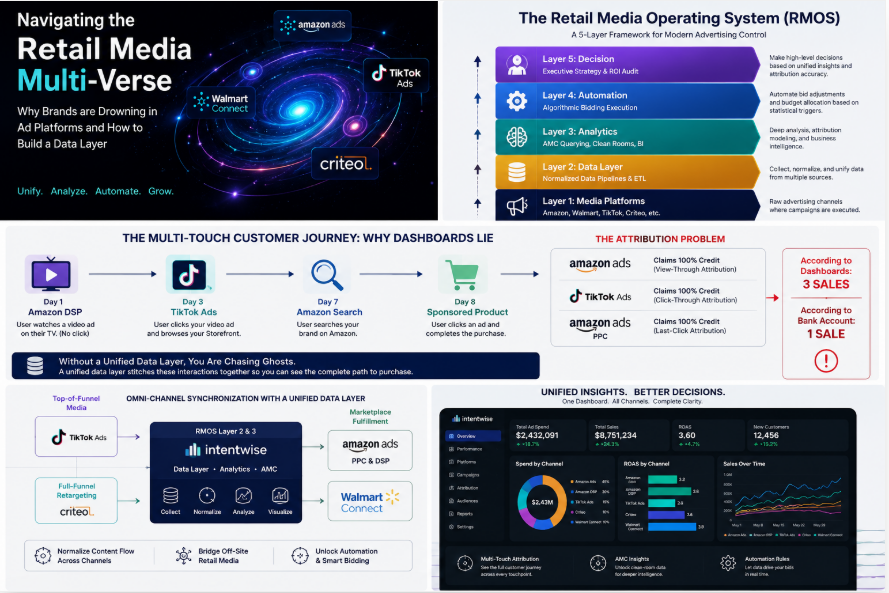
- Intentwise: As your brand scales, managing cross-channel retail infrastructure (such as expanding from an independent storefront into major online retail marketplaces) becomes highly complex. Intentwise aggregates multi-platform advertising, inventory, and margin data into a singular view. It provides automated optimization rules that dynamically adjust ad spend based on real-time parameters—such as lowering top-of-funnel ad spend if regional warehouse inventory for the Artemis Mask drops below a critical threshold. This prevents a misallocation of capital, locking down the denominator of your ROI equation.