
For modern eCommerce brands and advanced media buyers, the era of managing advertising within isolated platform dashboards is officially dead. As consumer journeys fragment across search, streaming, and social channels, the sheer volume of data generated is creating unprecedented operational complexity. The core bottleneck to scaling a global brand is no longer just budget allocation—it is data alignment.
When a brand expands its footprint to encompass Amazon Sponsored Ads, Amazon DSP, Walmart Connect, TikTok, and Criteo, it inadvertently creates highly siloed data structures. Manual data aggregation via Excel or localized scripts often leads to significant operational friction, lagging analysis, and misaligned attribution.
Platforms like Intentwise have emerged not as simple bidding execution software, but as foundational infrastructure designed to transition brands from fragmented execution into structured, data-driven omni-channel orchestration. Below is an objective, tactical analysis of where Intentwise fits into the enterprise advertising stack, its core architectural advantages, and its explicit operational boundaries.
1. The Core Pillar: Solving the Amazon DSP & AMC Attribution Enigma
For brands deploying capital into upper- and mid-funnel strategies, Amazon DSP (Demand-Side Platform) represents a highly sophisticated mechanism for audience acquisition and retargeting. However, managing Amazon DSP natively presents structural challenges: data fragmentation, unintuitive native user interfaces, and the critical lack of transparent, cross-channel attribution.
Intentwise addresses this friction not by overriding Amazon’s infrastructure, but by unifying the end-to-end data layers via the Intentwise Analytics Cloud and Intentwise Explore.
The Multi-Touch Attribution Bridge
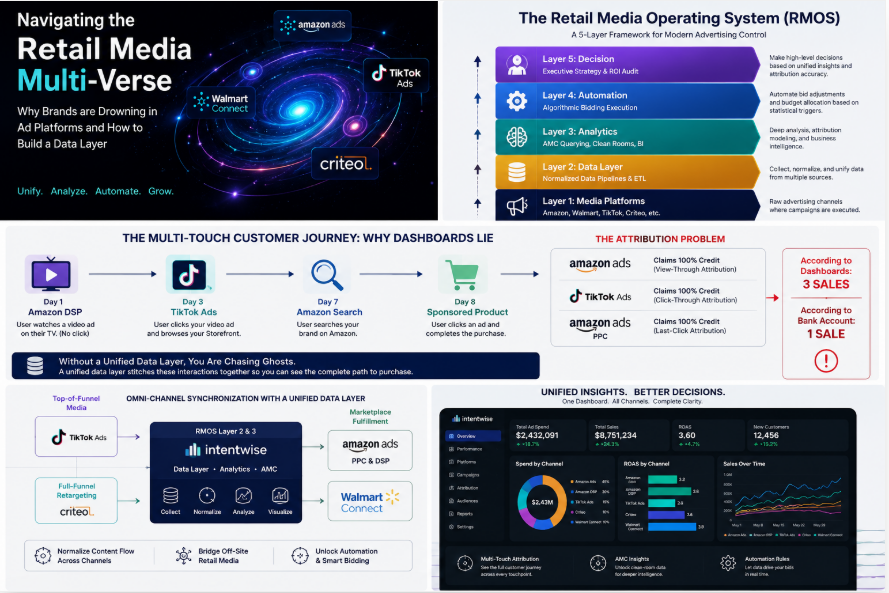
Historically, a common tactical challenge has been tracking the precise interplay between a top-of-funnel DSP programmatic video impression and a subsequent bottom-of-funnel conversion via an Amazon Sponsored Brand or Product ad.
By programmatically stitching Sponsored Ads data alongside Amazon DSP metrics, the platform provides clear visualization into the holistic consumer journey. Advanced operators can construct definitive multi-touch attribution models, ensuring that programmatic budgets are evaluated on long-term capital efficiency rather than inaccurate, isolated last-click metrics.
Democratizing Amazon Marketing Cloud (AMC)
The true frontier of Amazon advertising optimization resides within the Amazon Marketing Cloud (AMC)—a secure, clean-room environment allowing for custom SQL-based queries of raw event-level data. The primary operational barrier to AMC has always been technical; most advertising teams lack dedicated data scientists or SQL developers to query the clean room efficiently.
Intentwise acts as a critical low-code/no-code interface layer over AMC. It translates highly complex event-level datasets into digestible, actionable dashboards. For example, marketing teams can easily track precise audience overlap, optimal frequency capping (the point of diminishing returns on ad spend), and cross-channel lifetime value (LTV) without writing a single line of raw code.
2. Omni-Channel Orchestration: Unifying Amazon, Walmart, Criteo, and TikTok
As enterprise DTC brands move toward omni-channel diversification, managing cross-platform retail media networks introduces compounding data noise. A typical growth strategy involves top-of-funnel customer acquisition on TikTok Ads, dynamic full-funnel retargeting via Criteo, and marketplace fulfillment across Amazon and Walmart Connect.
Without a unified data layer, evaluating the Marketing Efficiency Ratio (MER) across these distinct touchpoints becomes an imprecise, retrospective guessing game.
Streamlining the Cross-Platform Data Layer
Intentwise’s data integration infrastructure programmatically ingests multi-channel performance data, mapping disparate data streams into a standardized framework.
- TikTok Ads to Marketplace Funnels: It captures real-time dynamic ad spend and top-of-funnel traffic signals from TikTok, positioning them adjacent to bottom-of-funnel marketplace conversions.
- Criteo & Off-Site Retail Media: It integrates Criteo’s extensive retail media network performance, allowing media buyers to evaluate off-site programmatic web banners against native marketplace search campaigns.
- Walmart Connect & Omni-Retail Data: For brands expanding beyond Amazon, it aligns Walmart Sponsored Search and Walmart DSP data alongside existing marketplace metrics, enabling an apple-to-apples comparison of cross-platform ROAS.
Algorithmic Safeguards and Automation
Through Intentwise Optimize, the platform allows media buyers to deploy programmatic rule-based logic across these unified data streams. Rather than relying on human operators to continuously monitor distinct dashboards, teams can implement automated bidding parameters and budget fluidities governed by strict statistical thresholds. This shifts the media buyer’s role from low-level manual optimization to high-level strategic architecture.
3. Ideal Ideal User Profiles vs. Clear Boundary Limits
To maintain analytical rigor, it is essential to emphasize that enterprise-grade data platforms are not universally applicable solutions. They possess distinct operational boundaries and are engineered for specific organizational maturity levels.
Who Is This Infrastructure Ideally Built For?
- Established Multi-Channel Brands: Organizations actively scaling ad spend across Amazon (PPC + DSP), Walmart, and off-site social or programmatic channels, where manual data consolidation consumes excessive engineering or operational hours.
- Data-Driven Agencies & Aggregators: Teams managing vast portfolio entities that require uniform, programmatically verified data layers to feed into internal BI visualization tools like Metabase or data pipelines like Airbyte.
- Sophisticated Media Teams Utilizing AMC: Advertisers who recognize the competitive necessity of extracting event-level insights from the Amazon Marketing Cloud but require a streamlined interface to fast-track strategic execution.
Clear Boundary Conditions: Who Should Reconsider?
- Early-Stage Marketplace Sellers: Brands whose revenue profiles and advertising strategies remain 95% dependent on native Amazon or Walmart keyword search campaigns. If your team’s monthly advertising structures can be managed comprehensively within native platform consoles, introducing a high-tier enterprise SaaS will introduce unnecessary fixed overhead and operational clutter.
- Teams Lacking Data Readiness: If an organization lacks the internal processes to translate advanced multi-channel attribution and clean-room insights into iterative, strategic media changes, the data layer will simply become an expensive visual dashboard rather than an active engine of growth.
Final Strategic Assessment
In the modern retail media landscape, the brands that win are not those with the highest budgets, but those with the clearest visibility into their data variables. Intentwise has positioned itself as a highly mature, stable ecosystem player by focusing squarely on data integration, normalization, and algorithmic automation across the major nodes of global commerce.
For advanced operators managing intricate, multi-layered digital funnels—where TikTok sparks awareness, Criteo handles web-wide consideration, and Amazon/Walmart capture the ultimate transaction—unifying these data streams into a singular layer is a logical step toward driving long-term capital efficiency and absolute order in ad spend.