
For years, veterans of the Amazon marketplace viewed Helium 10 through a relatively narrow lens. It was the industry-standard sandbox for product discovery and reverse-ASIN keyword research—the place you went to run Cerebro or Magnet before launching a product.
However, as the Amazon advertising landscape has matured into a highly congested, multi-variable battlefield, the platform’s utility has undergone a profound structural shift. Today, managing Amazon PPC manually is no longer a question of effort; it is a question of structural complexity. A single account can easily balloon into hundreds of campaigns, thousands of ad groups, and tens of thousands of targets.
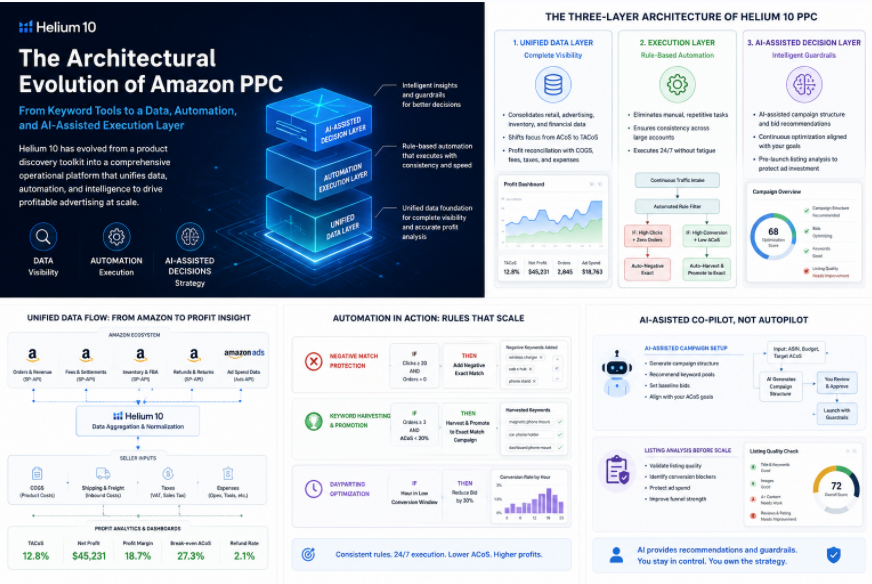
This evolution explores how Helium 10 (specifically through its advanced advertising engine, formerly known as Adtomic) has transitioned into a holistic system of record—deconstructing its role across three distinct institutional dimensions: The Data Layer, The Automation Layer, and the AI-Assisted Decision Layer.
1. The Unified Data Layer: Shifting the Paradigm from ACoS to Value Extraction
A perennial frustration among seasoned media buyers is the siloed nature of Amazon’s native advertising console. Evaluating advertising in isolation inevitably leads to an operational trap: lowering bids to suppress an aggressive ACoS, only to watch organic keyword rankings plummet, leading to an overall degradation of net margin.
Helium 10 addresses this structural disconnect by unifying disparate data streams—fusing retail performance, inventory costs, and multi-channel advertising into a singular, cohesive ledger.
Macro Diagnostics via TACoS
Instead of allowing brand managers to obsess over localized Advertising Cost of Sales (ACoS), the platform forces focus toward Total Advertising Cost of Sale (TACoS). By contextualizing total ad spend against global account revenue (organic plus sponsored), operators gain macro-level visibility:
- The High-Dependence Trait: Identifying products where an apparently “healthy” ACoS is masking a dangerous reliance on paid traffic, signaling that organic traction is not being achieved.
- The Rank-Multiplier Effect: Validating scenarios where an elevated local ACoS is acceptable because it is demonstrably driving organic market share and lowering the overarching TACoS.
The Profit Reconciliation Model
A true operational dashboard must bridge the gap between ad spend and actual supply chain realities. Through its integration with store health metrics, the system pulls historical data via the Amazon Selling Partner API (SP-API) and reconciles it against custom seller inputs to approximate genuine operational profitability.
By incorporating Product Costs (COGS), inbound freight, localized tax structures, and customizable operating expenses (such as digital photography, agency retainer fees, or external SaaS costs), the platform shifts the conversation. Media buyers are no longer optimizing for abstract ad-attributed revenue; they are optimizing for true residual business margin.
2. The Execution Layer: Reducing System Complexity Through Rule-Based Automation
The day-to-day management of enterprise-scale PPC portfolios is notorious for its administrative friction. Highly skilled strategists routinely spend hours downloading search term reports, manipulating data arrays in Excel, isolating long-tail phrases, and manually executing negative matches. This overhead represents an escalation of operational disorder.
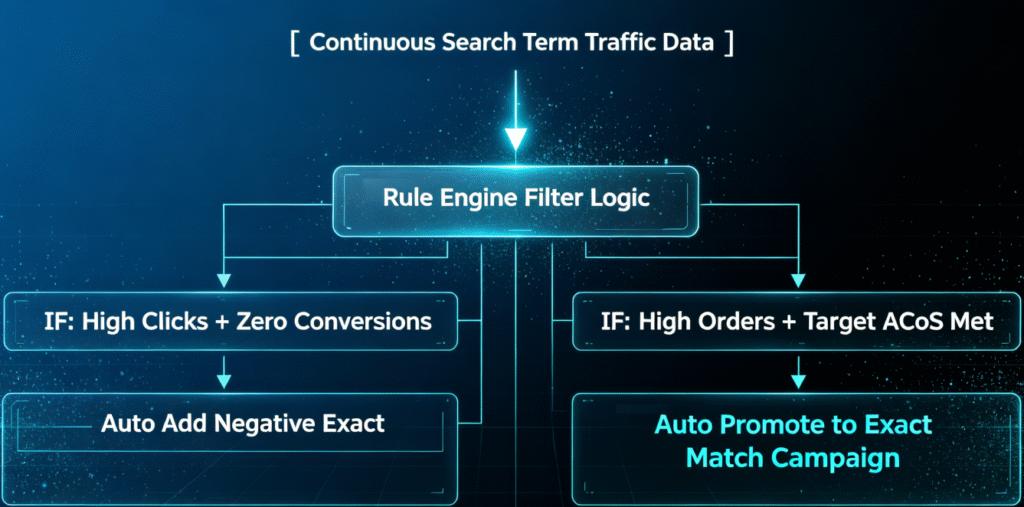
The platform mitigating this through its structured Rule Engine transforms manual workflow loops into programmatic, asynchronous execution.
Keyword Harvesting and Search Term Promotion
Experienced operators understand that a Keyword (the targeting parameters set inside the campaign) is structurally distinct from a Search Term (the actual string entered by a human shopper). A single phrase-match keyword can trigger hundreds of unique customer search terms.
The rule engine acts as an automated sorting filter. By establishing firm logical bounds—such as:
IFa specific customer search term generates X orders under a benchmark ACoS threshold,THENprogrammatically harvest that term and promote it as an isolated target inside a designated Exact Match campaign.
This ensures that high-velocity search terms are systematically insulated and given dedicated budget allocations without human intervention.
Algorithmic Attrition Prevention (Negative Targeting)
Conversely, capital leakage occurs in the long tail—search queries that accumulate clicks across phrase or automatic campaigns without converting. Strategists can define stringent attrition guardrails:
IFa search term crosses a specified click threshold (e.g., 20 clicks) with zero conversions,THENautomatically apply a Negative Exact match at the corresponding ad group or campaign level.
This algorithmic pruning prevents unmitigated spend variance and systematically drives the account toward structural efficiency.
Systemic Dayparting
While Amazon’s native ecosystem has introduced basic budget scheduling, elite-tier performance requires optimizing placement timing based on historical performance velocity. The platform allows operators to design custom Dayparting schedules, adjusting bids or pausing campaigns based on the historical conversion windows of a specific catalog. This ensures capital is deployed when consumer intent is statistically at its highest frequency, minimizing exposure during low-converting off-hours.
3. The AI-Assisted Decision Layer: Guardrails Over Full Autonomy
There is a distinct line between enterprise-grade operational software and sensationalized marketing narratives surrounding Artificial Intelligence. In sophisticated brand management, fully autonomous “black-box” AI systems—where an algorithm claims to manage an entire brand portfolio without visibility or control—are treated with appropriate skepticism. Market dynamics are too volatile, and inventory constraints too critical, to cede absolute control.
Helium 10’s modern architecture positions its AI features under an AI-Assisted Automation model. It functions as an intelligent co-pilot and structural validator rather than an unguided driver.
| Operational Dimension | Traditional Manual Management | AI-Assisted Automation Model |
| Campaign Construction | Manually segmenting auto, broad, and exact groups; mapping budgets individually. | Automated structural instantiation based on target ASIN, initial capital allocation, and target ACoS. |
| Bidding Corrections | Periodic manual adjustments based on subjective interpretation of lookback windows. | Continuous programmatic bid recommendations aligned with dynamic optimization loops. |
| Optimization Velocity | Highly dependent on human schedule; prone to lag or operational oversights. | Asynchronous, continuous processing of performance signals to maintain target constraints. |
Structural Recommendations and Continuous Calibration
When deploying new campaigns, the AI does not operate in a vacuum. By evaluating the historical performance of the ASIN alongside the brand’s stated capital constraints (such as a defensive vs. aggressive market-share acquisition posture), the system constructs recommended campaign frameworks. It populates these with initial keyword pools, negative seed targets, and baseline bids.
Crucially, the platform avoids arbitrary, rigid timelines for model “convergence.” Acknowledging that a high-velocity, 500-order-a-day catalog will generate actionable data far faster than a premium, low-velocity niche item, the AI dynamically adjusts its optimization tempo based on continuous data density. It self-calibrates continuously, scaling its recommendation confidence as the statistical sample size grows.
Pre-Launch Contextual Validation
An advertising campaign is only as effective as the conversion engine behind it: the product listing. To prevent operators from forcing traffic into a flawed funnel, the platform leverages integrated cross-tool diagnostics (Listing Analyzer, Listing Builder).
Before significant ad spend is committed, the system flags downstream structural weaknesses—such as insufficient indexation of core backend search terms, subpar image counts, or weak review velocity relative to the competitive set. This structural alert mechanism ensures that advertising capital is directed toward listings that possess the foundational architecture necessary to convert paid impressions into realized revenue.
Institutional Summary: The Shift to Operational Maturity
Ultimately, the transformation of Helium 10’s advertising ecosystem reflects a broader maturation within the e-commerce industry. The platform is best understood not as a replacement for human intellect, but as an institutional Data and Execution Layer.
By pulling fragmented platform reports, financial variables, and keyword metrics into a singular dashboard, it resolves structural visibility issues. By executing human-defined logic through robust automation rules, it drastically lowers administrative friction.
For the modern brand architect or senior consultant, its true utility lies in its ability to strip away the chaotic, manual overhead of campaign maintenance—allowing the operator to step out of the execution mud and focus entirely on high-level portfolio strategy, positioning, and capital allocation.